history of Yadadri Sri Lakshmi Narasimha Swamy Temple
The history of Yadadri Sri Lakshmi Narasimha Swamy Temple is a remarkable journey that blends faith, tradition, royal patronage, and architectural excellence. Perched on the sacred Yadagirigutta Hill in present-day Yadadri Bhuvanagiri district of Telangana, the temple has evolved over centuries from a small cave shrine into one of India’s most celebrated pilgrimage centres. Today, it stands as a symbol of Telangana’s spiritual identity while preserving traditions that have been cherished for generations.
Click To Read : Yadadri History Sthalapuranam Architechture Pancha Narasimha Visitor Guide
Ancient Origins
The earliest history of Yadadri is closely associated with ancient Hindu traditions. Long before the construction of grand temple structures, the hill was revered as a sacred place of meditation and worship. The original shrine was located inside a natural cave, where devotees worshipped Lord Lakshmi Narasimha in a serene and secluded environment. Over time, this sacred cave became the spiritual heart of the temple, attracting pilgrims from nearby villages and distant regions alike. Although the exact date of the temple’s origin is unknown, religious traditions indicate that the shrine has been a place of continuous worship for many centuries.
Growth Through the Medieval Period
As devotion to Lord Narasimha spread across South India, Yadadri gradually gained prominence as an important Vaishnavite pilgrimage centre. Successive generations of devotees, local rulers, and religious scholars contributed to the development of the shrine by improving pathways, constructing mandapams, and supporting temple rituals. Historical references also indicate that the temple enjoyed the patronage of regional dynasties, helping it grow into a respected centre of worship while preserving its ancient traditions. (Yadadri Bhuvanagiri District)
Royal Patronage and Continued Worship
Throughout its long history, Yadadri continued to receive support from various rulers who recognised its religious importance. Records suggest that the temple remained an active place of pilgrimage during different political periods, including the rule of the Hyderabad State. Such patronage helped maintain daily worship, temple administration, and facilities for visiting devotees. Despite changes in kingdoms and governments, the spiritual significance of Yadadri remained unchanged, with devotees continuing to visit the sacred hill in large numbers.
Transformation into Modern Yadadri
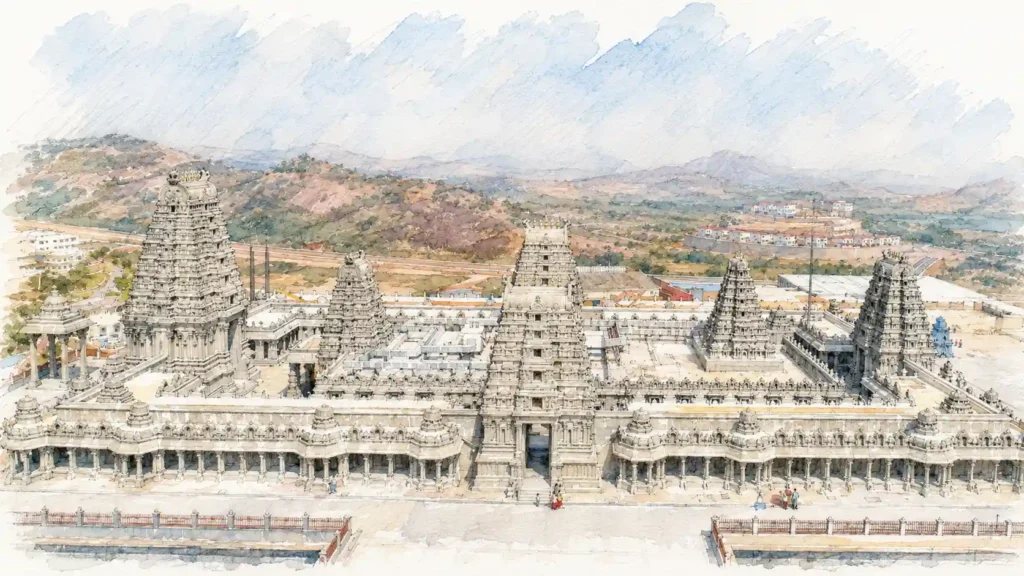
A major turning point in the temple’s history came after the formation of Telangana State. Recognising Yadadri as one of the state’s most important spiritual landmarks, an ambitious redevelopment project was undertaken to restore the temple’s traditional grandeur while preserving its sacred cave shrine. The earlier structures were carefully replaced with a magnificent stone temple designed according to ancient Agama Shastra principles and traditional South Indian temple architecture. Thousands of skilled artisans, sculptors, and sthapathis worked for several years, carving intricate sculptures from Krishna Shila (black stone) and creating a temple complex that reflects India’s timeless architectural heritage.
A New Era of Spiritual Heritage
The reconstructed temple was ceremonially reopened to devotees in March 2022, marking the beginning of a new chapter in Yadadri’s history. While the temple now features grand gopurams, spacious mandapams, beautifully sculpted pillars, and improved facilities for pilgrims, the original cave shrine continues to remain the spiritual centre of the complex. This careful balance between preserving ancient sanctity and embracing thoughtful development has made Yadadri a unique example of heritage conservation in modern India.
Yadadri Today
Today, Yadadri Temple welcomes millions of devotees every year and is regarded as one of the most important Narasimha temples in the country. Beyond being a place of worship, it has become a centre for cultural preservation, traditional temple architecture, and religious tourism. The temple’s remarkable transformation has strengthened its position as one of Telangana’s greatest spiritual landmarks, ensuring that its legacy continues to inspire future generations while remaining deeply rooted in centuries-old faith and devotion.