Architecture of the Yadadri Temple – A Timeless Masterpiece of Stone and Devotion
Architecture of the Yadadri Temple : The magnificent Yadadri Sri Lakshmi Narasimha Swamy Temple that greets devotees today is the result of an extraordinary transformation that combines ancient Indian temple architecture with modern planning. While preserving the sanctity of the original cave shrine, the temple has been rebuilt into one of the finest examples of traditional all-stone architecture in contemporary India. Every pillar, sculpture, mandapam, and gateway reflects the skill of master craftsmen and the timeless principles of Agama Shastra, Shilpa Shastra, and Vastu Shastra.
More than a place of worship, the new Yadadri Temple stands as a tribute to India’s rich temple-building heritage, proving that centuries-old craftsmanship continues to thrive even in the modern era.
Click To Read : Yadadri History Sthalapuranam Architechture Pancha Narasimha Visitor Guide
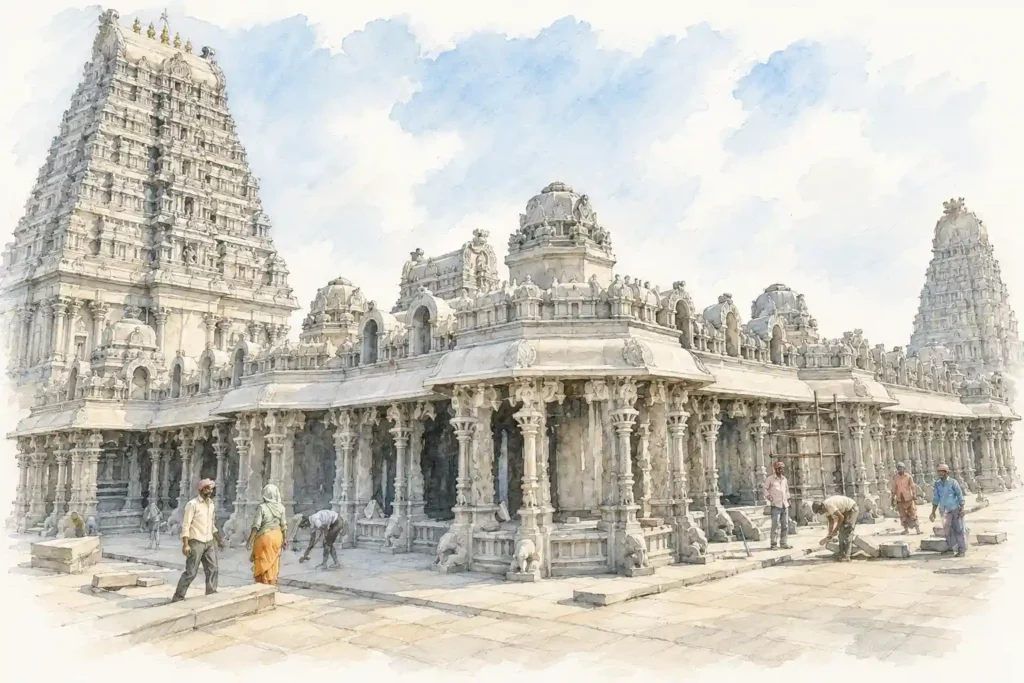
The Temple Before the Grand Reconstruction
For generations, devotees worshipped Lord Lakshmi Narasimha in a modest temple built around the ancient sacred cave on Yadagirigutta Hill. Although spiritually significant, the earlier temple was comparatively small and had evolved gradually over time through additions made during different periods.
As the number of pilgrims increased year after year, the temple began facing practical challenges. The queue lines were narrow, space around the sanctum was limited, and facilities for devotees could no longer comfortably accommodate the growing crowds. During major festivals, thousands of pilgrims gathered on the hill, making expansion essential while ensuring that the original cave shrine remained untouched.
Despite its simplicity, devotees deeply cherished the old temple because it preserved the sacred cave where Lord Lakshmi Narasimha is traditionally believed to have manifested before Sage Yada. Protecting this ancient spiritual centre became the guiding principle for every stage of the reconstruction.
A Vision to Revive India’s Temple Heritage
Following the formation of Telangana, an ambitious project was undertaken to transform Yadadri into a world-class pilgrimage destination while remaining faithful to traditional Hindu temple architecture. Rather than constructing a modern reinforced-concrete structure, the vision was to create a temple that would resemble the great stone temples built by India’s master artisans centuries ago.
The redevelopment was planned under the guidance of renowned temple architect Anand Sai, working alongside experienced sthapathis, sculptors, engineers, and Agama scholars. Every design element—from the orientation of the sanctum to the proportions of the towers and mandapams—was carefully planned in accordance with ancient architectural scriptures.
The objective was not merely to build a larger temple, but to create a spiritual monument that would inspire future generations while preserving the sanctity of the original shrine.
From a Modest Shrine to a Monumental Stone Temple
One of the most remarkable aspects of the reconstruction is the decision to build the temple almost entirely from natural stone instead of conventional concrete.
Approximately 2.5 lakh tonnes (250,000 tonnes) of Krishna Shila (black granite) were used in the project. This stone was chosen for its exceptional durability, strength, natural cooling properties, and suitability for intricate carving. For centuries, Krishna Shila has been favoured in South Indian temple construction because it can withstand changing weather conditions while retaining its beauty for generations.
The temple complex expanded significantly, transforming the hill into a spacious pilgrimage centre with grand entrance gateways, wide pathways, beautifully designed mandapams, and improved facilities for devotees. Throughout this transformation, the ancient cave shrine remained the spiritual heart of the temple, symbolising the seamless connection between the past and the present.
The Extraordinary Craftsmanship of the Shilpis
Perhaps the greatest achievement of the reconstruction lies in the dedication of the thousands of artisans who brought the temple to life.
More than 2,000 traditional sculptors (Shilpis), supported by thousands of skilled workers, engineers, and craftsmen, devoted several years to carving every architectural element by hand. Instead of relying on machine-made decorative panels, the artisans followed centuries-old carving techniques that have been passed down through generations.
Each pillar, beam, ceiling panel, and doorway was individually sculpted with extraordinary attention to detail. The carvings depict divine figures, celestial beings, floral patterns, sacred animals, and motifs inspired by classical Hindu art. Walking through the temple, visitors can appreciate how every stone has been transformed into a work of devotion rather than merely a structural component.
Their craftsmanship reflects the enduring legacy of India’s traditional temple builders and demonstrates that ancient artistic skills continue to flourish in the present day.
A Celebration of Traditional Temple Architecture
The architecture of Yadadri beautifully combines the elegance of Dravidian temple architecture with artistic influences associated with the historic Kakatiya tradition of Telangana.
The towering gopurams, spacious mandapams, sculptured pillars, decorative ceilings, and symmetrical layout reflect the principles followed in classical South Indian temples. Every structure has been designed not only for visual grandeur but also to create a spiritually uplifting experience for pilgrims.
Unlike modern buildings that often prioritise speed of construction, traditional temple architecture emphasises permanence, proportion, symbolism, and harmony. These timeless principles are visible throughout the Yadadri Temple complex, giving it a majestic appearance while maintaining its sacred character.
Stone Carvings That Tell Sacred Stories
One of the most captivating features of the new temple is its rich collection of stone sculptures.
Visitors will find beautifully carved representations of various deities, Garuda, lions, elephants, lotus motifs, sacred symbols, and ornamental designs inspired by Hindu traditions. Decorative pillars and ceilings display remarkable craftsmanship, while many carvings reflect episodes from Hindu mythology and the spiritual ideals associated with Lord Vishnu.
Rather than serving as mere decoration, these sculptures educate devotees, preserve cultural traditions, and communicate religious values through visual art. Every carving has been created with symbolic meaning, encouraging visitors to pause, observe, and reflect upon the deeper philosophy represented in stone.
Symbolism Woven into Every Stone
Traditional Hindu temple architecture is built on the belief that every architectural element carries spiritual meaning.
The gopuram represents the devotee’s journey from the material world towards the Divine. The lotus motifs symbolise purity and spiritual awakening. Lions signify courage and divine protection, while elephants represent strength, stability, and wisdom. Garuda, the divine vehicle of Lord Vishnu, symbolises unwavering devotion and surrender to God.
At the centre of this magnificent stone complex lies the ancient cave shrine, reminding every pilgrim that despite the temple’s modern grandeur, its true essence continues to rest in the sacred place where centuries of devotion began.
Interesting Facts About the Reconstruction
- The temple was reconstructed using approximately 2.5 lakh tonnes of Krishna Shila (black granite).
- The redevelopment was carried out over several years while preserving the original sacred cave shrine.
- More than 2,000 traditional sculptors participated in the carving work, supported by thousands of craftsmen and workers.
- The redesigned temple complex is substantially larger than the earlier shrine, enabling it to accommodate far more pilgrims and improve visitor facilities.
- Every major architectural component was planned according to the principles of Agama Shastra, Shilpa Shastra, and Vastu Shastra.
- The project has revived traditional stone temple construction on a scale rarely seen in modern India.
A Living Legacy for Future Generations
The reconstruction of Yadadri Temple is far more than an architectural achievement. It represents the revival of an ancient tradition where faith, art, engineering, and craftsmanship come together in perfect harmony. By preserving the sacred cave while surrounding it with an intricately carved stone temple, Yadadri has created a bridge between centuries-old devotion and the aspirations of modern pilgrims. Today, the temple shines not only as one of Telangana’s most revered spiritual destinations but also as a lasting symbol of India’s architectural excellence. Every stone, every sculpture, and every carved pillar reflects the devotion of countless artisans whose work will continue to inspire generations of devotees, historians, architects, and visitors from around the world.