Understanding the Chaturveda Devatas : The Divine Guardians of Knowledge
In the profound philosophy of Indian spiritual thought, the universe is not seen as a chaotic collection of matter, but as a highly organized cosmic machinery. This concept is rooted in the belief that every aspect of Srushti (Creation) is governed by a specific conscious power known as an Adhishtana Devatha (Presiding Deity).
Just as we have the Ashta Dikpalakas (Guardians of the Eight Directions) to protect space, and the Navagrahas (Nine Planets) to influence time and karma, our ancient seers realized that even the highest forms of knowledge—the Vedas—possess their own divine personified forms. These forms are not mere artistic imaginations but are symbolic representations of the energy and purpose each Veda carries.
The Architecture of the Chaturvedas
The Vedas are the primordial breath of the Divine, divided into four primary streams by Sage Veda Vyasa to ensure the spiritual well-being of humanity.
Rigveda: The Foundation of Praise
As the oldest of the four, the Rigveda is a collection of 10,552 mantras organized into 10 Mandalas. It is primarily dedicated to the praise of deities like Agni, Indra, and Varuna.
- The Presiding Deity: As per the ancient texts, the deity of Rigveda is described as:
Rigvedah Shwetavarnasyat Dwibhujo Rasabhananah ||
Akshamaladhara Saumyah Prito Vyakhyakritodyamah ||
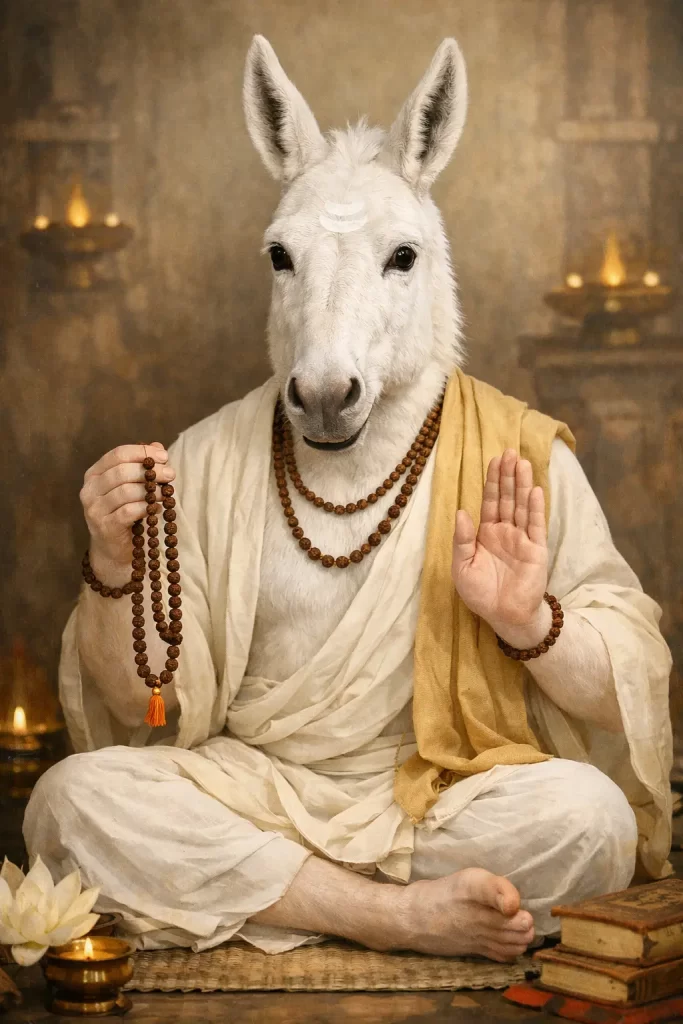
Symbolism: He is white (Shweta) in color, symbolizing purity and the light of consciousness. Interestingly, he has the face of a donkey (Rasabha). In spiritual symbolism, the donkey represents the capacity for tireless labor and the bearing of the “burden” of sacred knowledge without complaint. He holds a prayer mala and is seen in a teaching posture (Vyakhya), emphasizing that Rigveda is the source of all explanations.
For Rigveda AGNI is pradhana adhidevatha
Yajurveda: The Science of Action
The Yajurveda (divided into Shukla and Krishna) contains about 1,975 mantras and focuses on the ritualistic application of knowledge—Yagna. It is the “Veda of Karma.”
- The Presiding Deity: As per the ancient texts, the deity of Yajurveda is described as:
Ajasya Peetavarnasyat Yajurvedo-Akshasutradhrut ||
Vame Kulishapanistu Bhutido Mangalapradah ||
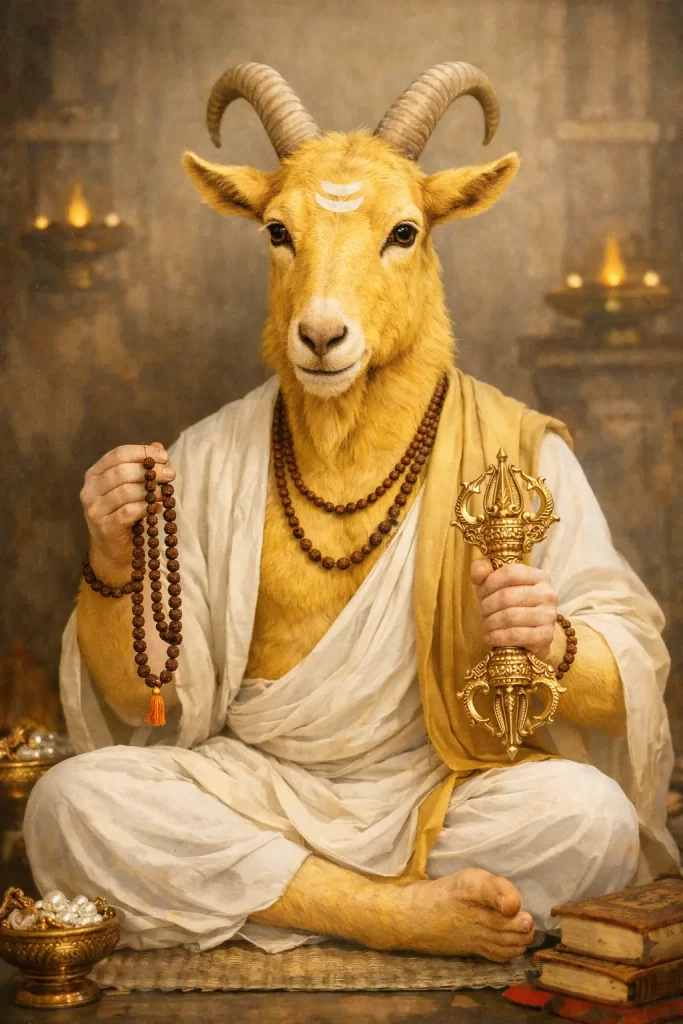
Symbolism : He is yellow (Peeta), signifying fire, energy, and sacrifice. He has the face of a goat (Aja). In Vedic rituals, the goat represents the sacrificial element of the ego. He holds a Kulisha (Vajra/Thunderbolt) in his left hand, symbolizing the power and discipline required to perform Vedic rites accurately.
For Yajurveda VAYU is pradhana adhidevatha
Samaveda: The Melody of Devotion
With 1,875 mantras, most of which are derived from the Rigveda but set to musical notes, the Samaveda is the Veda of Chants. It is said that “among the Vedas, I am Samaveda,” according to Lord Krishna in the Bhagavad Gita.
- The Presiding Deity: As per the ancient texts, the deity of Samaveda is described as:
Nilotpala Dalashyamo Samavedo Hayananah |
Akshamalanvito Dakshevame Kumbhadharah Smrutah ||
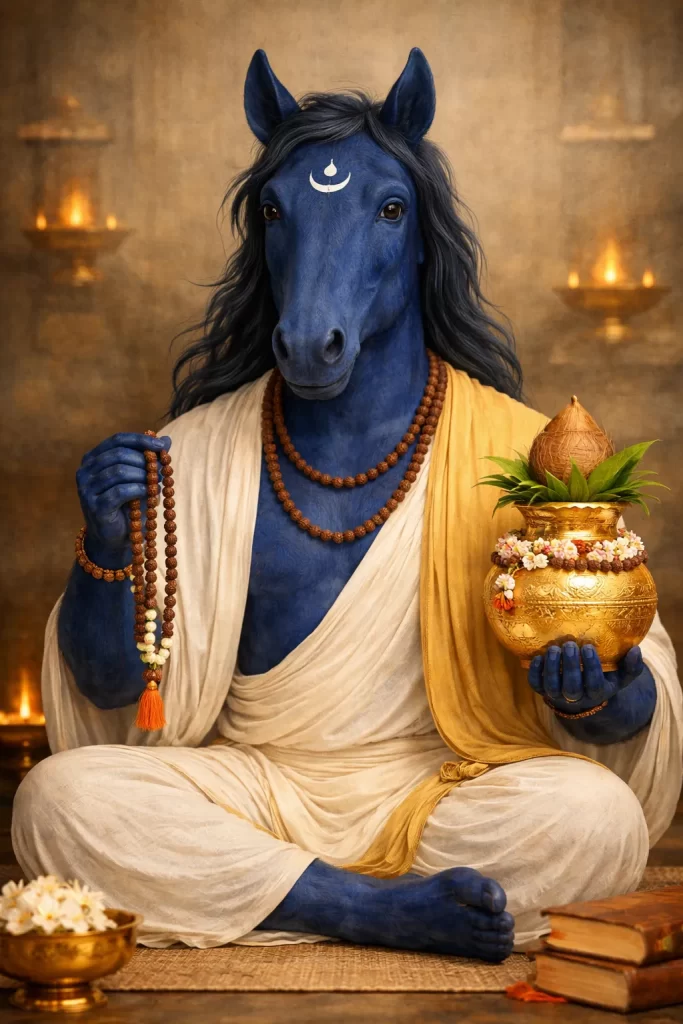
Symbolism : He is dark blue (Shyama) like a blue lotus, representing the depth of the infinite and the peace of music. He has the face of a horse (Haya). The horse (Hayagriva form) is a symbol of speed and the vital breath (Prana) used in chanting. He carries a Kumbha (Pot) containing the nectar of immortality achieved through devotion.
For Samaveda SURYA is pradhana adhidevatha
Atharvaveda: The Wisdom of Daily Life
The Atharvaveda contains 5,977 mantras dealing with medicine, protection, and the science of living a healthy, long life on Earth.
- The Presiding Deity : As per the ancient texts, the deity of Atharvanaveda is described as:
Atharvanabhidho Vedo Dhavalo Markatananah |
Akshamalanvito Vamedakshe Kumbha Dharah Smrutah ||
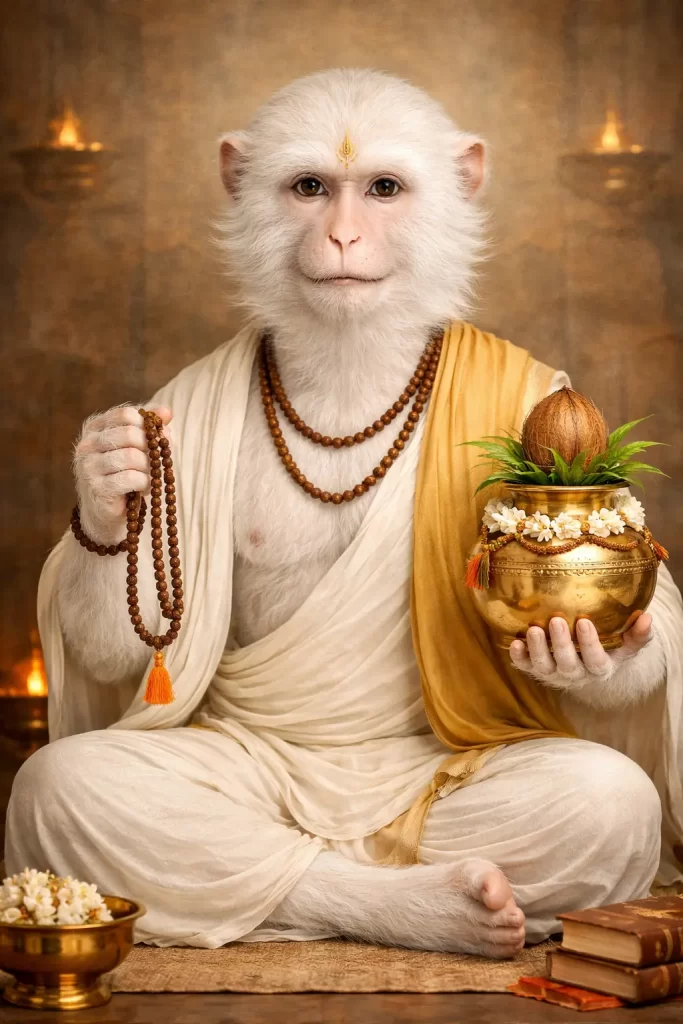
Symbolism : He is dazzling white (Dhavala) and has the face of a monkey (Markata). The monkey represents the restless mind that is tamed through the practical applications and protective chants found in this Veda. He also carries a Kumbha, representing the healing herbs and medicinal knowledge he guards.
For Atharvaveda VARUNA is pradhana adhidevatha
Importance and Human Well-being
In the Purana Kala (ancient times), the practice of the Vedas was the backbone of society. The Varna-Ashrama system ensured that these vibrations were constantly chanted, maintaining the “Rta” (Cosmic Order). People believed that the vibrations of the Rigveda purified the mind, Yajurveda purified our actions, Samaveda balanced our emotions, and Atharvaveda protected our physical health.
In the Present Day, while the number of full-time practitioners has decreased, the essence of the Vedas remains indispensable.
- Yoga and Ayurveda (derived from Atharvaveda) are now global phenomena.
- Homas and Poojas (Yajurveda) are performed for mental peace and environmental purification.
- Vedic Chanting has been recognized by UNESCO as a masterpiece of the “Intangible Heritage of Humanity” due to its precise phonetic structure that impacts the human brain’s neural pathways.
Conclusion
The concept of the Chaturveda Devatas teaches us that knowledge is not just information—it is a living, breathing energy. By visualizing the Vedas as deities with specific forms, Indian tradition helps us connect emotionally and spiritually with the wisdom they contain. Whether it is the tireless service of the Rigveda or the melodic peace of the Samaveda, these powers continue to guide human evolution.
The Four Pillars The Chaturvedas | Sri Rama Navami
Gyanavedam Categories :
Analytical Articles | Children’s Stories | Education – Building Knowledge | History and Heritage | Indian Temples and Sacred Places | Knowledge & Facts | Do You Know | Sanathana Dharma | Videos & YouTube Channel