
The Four Pillars The Chaturvedas
The Four Pillars The Chaturvedas
The profound wisdom of the Sanatana Dharma (Eternal Way of Life) is preserved within the sacred vibrations of the Vedas. To understand the roots of Indian culture, one must delve into the vast ocean of Vedic literature, which serves as a manual for both spiritual liberation and worldly prosperity.
Based on the provided traditional texts, here is a comprehensive guide to the pillars of Indian heritage.
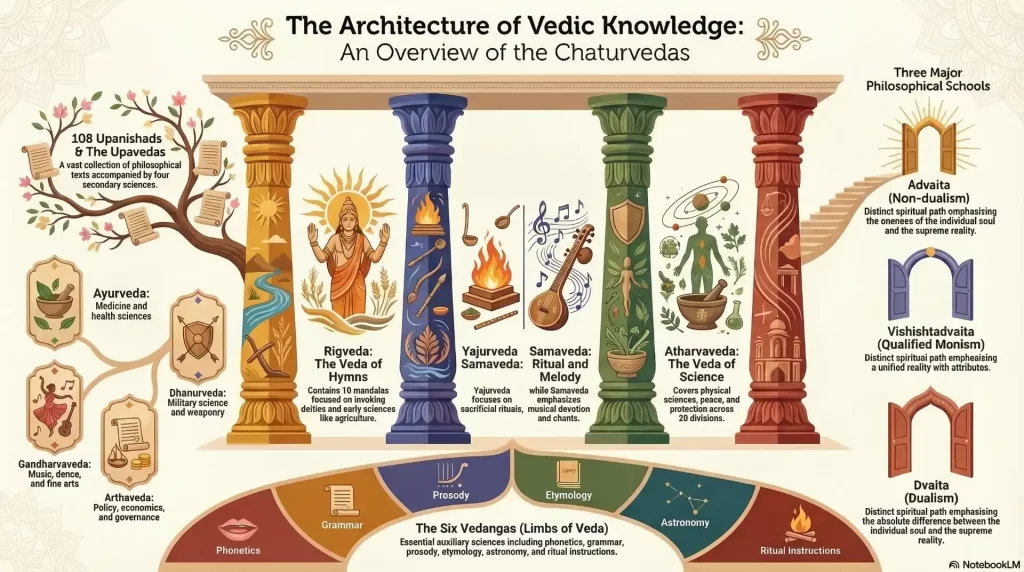
The Four Pillars: The Chaturvedas
The Vedas are considered divine revelations (Apaurusheya) and the breath of the Supreme Being. There are four primary Vedas, each serving a unique purpose in the cosmic order.
Rigveda: The Veda of Praise
The Rigveda is the oldest and is composed of “Riks” or verses bound by meter.
- Structure: It is divided into 10 Mandalas (circles) or 8 Ashtakas.
- Content: While famous for hymns to deities, it surprisingly contains advanced ancient sciences, including agricultural methods, trade, and even concepts related to shipbuilding, aircraft (Vimanas), and wireless communication.
- The Ritual: The priest known as the Hota uses these mantras to invite the deities to the sacrificial fire.
Yajurveda: The Veda of Rituals
The Yajurveda focuses on the “Yajus” or prose mantras used in sacrificial rites. It is split into two major branches:
- Krishna (Black) Yajurveda: Noted for the Taittiriya school, it contains sections on Samhita, Brahmana, and Aranyaka. It covers subjects like mathematics, anatomy, and space science.
- Shukla (White) Yajurveda: Known as the Vajasaneya Samhita, it consists of 40 chapters and is associated with the Shatapatha Brahmana.
- The Ritual: The Adhvaryu priest performs the primary physical actions of the Yagna using these mantras.
Samaveda: The Veda of Melodies
Samaveda is the science of devotion through music. “Sama” means song.
- Purpose: It is meant to be sung to please the deities.
- The Ritual: The Udgata priest chants these musical mantras during sacrifices. Tradition says it once had 1,000 branches, though very few remain today.
Atharvaveda: The Veda of Daily Life
The Atharvaveda deals with physical sciences, Brahma Vidya (knowledge of the Absolute), and social codes.
- Content: It covers agriculture, trade, and the duties of a student (Brahmacharya).
- The Ritual: The Brahma priest, who must be proficient in all Vedas, supervises the entire Yagna to ensure no errors are made.

The Divine Personifications of the Vedas
According to traditional iconography, each Veda has a specific divine form that reflects its characteristics:
| Veda | Appearance | Symbolism |
| Rigveda | White-colored, Donkey-faced, Two arms. | Holds an Akshamala (beads); represents explanation and peace. |
| Yajurveda | Yellow-colored, Goat-faced. | Holds a rosary and a Vajra (thunderbolt); grants prosperity. |
| Samaveda | Dark-blue (like a blue lotus), Horse-faced. | Holds an Akshamala and a Purna-Kumbha (pot). |
| Atharvaveda | White-colored, Monkey-faced. | Holds a rosary and a pot; represents physical and spiritual protection. |
Understanding the Chaturveda Devatas
The Structure of Vedic Wisdom: Vedangas and Upavedas
To fully grasp the Vedas, one must study the Vedangas (Limbs of the Vedas).
The Six Vedangas
- Shiksha: The science of phonetics and pronunciation.
- Vyakarana: Grammar, primarily established by Panini.
- Chandas: The science of poetic meters, authored by Pingala.
- Nirukta: Etymology and the explanation of difficult Vedic words.
- Jyotisha: Astrology and astronomy, used to determine the timing of rituals.
- Kalpa: The manual of rituals and procedures.
The Upavedas (Applied Knowledge)
These are secondary Vedas that apply spiritual principles to worldly sciences:
- Ayurveda: The science of medicine and health.
- Dhanurveda: The science of weaponry and statecraft.
- Gandharvaveda: The science of music and arts.
- Arthaveda: The science of economics, politics, and technology.
Philosophical Schools: Advaita, Vishishtadvaita, and Dvaita
Vedic thought culminated in the Upanishads (Vedanta), leading to three major philosophical interpretations regarding the relationship between the Soul (Jiva) and God (Brahman).
- Advaita (Non-Dualism): Propounded by Adi Shankaracharya. It teaches that the Soul and Brahman are one and the same; the world is an illusion (Maya), and only Brahman is real.
- Vishishtadvaita (Qualified Non-Dualism): Propounded by Ramanujacharya. It suggests that while the Soul and Nature are real, they exist as the body of God. Devotion (Bhakti) is the path to liberation.
- Dvaita (Dualism): Propounded by Madhvacharya. It emphasizes a clear distinction between God and the Soul, comparing their relationship to that of a master and a servant.
Living the Dharma: Purusharthas and Ashramas
Sanatana Dharma provides a roadmap for a balanced life through the Four Purusharthas (Goals of Life):
- Dharma: Righteousness and duty.
- Artha: Prosperity and wealth.
- Kama: Desire and enjoyment (within ethical limits).
- Moksha: Spiritual liberation.
This journey is supported by the Four Ashramas (Stages of Life): Brahmacharya (student), Grihastha (householder), Vanaprastha (hermit), and Sanyasa (renunciate).
Epics and Puranas: Lessons in Stories
Since the Vedas are complex, the Itihasas (History) and Puranas were created to teach Dharma through stories.
- Ramayana: The story of Rama, teaching the duties of a son, brother, and king.
- Mahabharata: Known as the “Fifth Veda,” it includes the Bhagavad Gita and covers every aspect of human morality.
- Puranas: There are 18 Maha Puranas describing the glories of the Divine, sacred geography, and historical lineages.
Conclusion The Sanatana tradition is not just a religion but a sophisticated system blending science, art, and spirituality. By understanding these foundational texts—from the rhythmic chants of the Rigveda to the deep philosophy of the Upanishads—we find a timeless guide for living a life of purpose and peace.
Gyanavedam Categories :
Analytical Articles | Children’s Stories | Education – Building Knowledge | History and Heritage | Indian Temples and Sacred Places
Knowledge & Facts | Do You Know | Sanathana Dharma | Videos & YouTube Channel
