
Raksha Bandhan The Sacred Bond of Love and Protection
India is often called the land of festivals, and rightly so. In Sanātana Dharma, festivals are not merely holidays marked on a calendar. They bring families together, preserve traditions, teach values to the next generation and add happiness and meaning to everyday life.
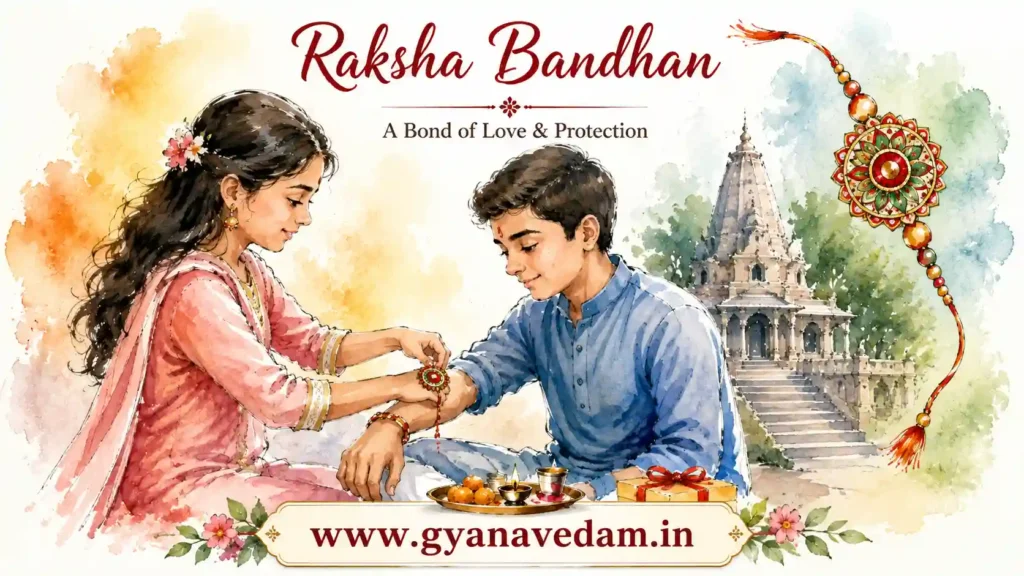
Among these beautiful festivals, Rakhi Pournami, popularly known as Raksha Bandhan, has a very special place.
Raksha Bandhan celebrates one of the purest human relationships—the affection between a brother and sister. A simple sacred thread tied around the wrist carries emotions that cannot be measured by its price. It represents love, prayer, responsibility, blessings and, above all, Raksha—protection.
Every year, as Shravan Purnima approaches, people eagerly search questions such as “Rakhi kab hai 2026?”, “Raksha Bandhan 2026 date”, “Rakhi Purnima 2026”, “Raksha Bandhan shubh muhurat 2026” and “Rakhi tying time 2026.”
But behind that search for a date lies something much deeper—the desire to meet someone we love.
When is Raksha Bandhan ?
Raksha Bandhan 2026 will be celebrated on Friday, August 28, 2026.
Raksha Bandhan is traditionally observed on the Purnima, or full-moon day, of the sacred Shravan month. For 2026, the Purnima Tithi begins at approximately 9:08 AM on August 27 and ends at 9:48 AM on August 28. Panchang calculations for different Indian cities therefore place the main Raksha Bandhan celebration on August 28.
The exact auspicious time can differ slightly according to location. For example, Panchang calculations for parts of Andhra Pradesh indicate a Rakhi ceremony period from around sunrise until 9:48 AM, with Bhadra ending before sunrise. Families following a traditional Panchang should check the local Raksha Bandhan Muhurat 2026 for their city.
What is Rakhi Pournami or Raksha Bandhan?
The Sanskrit words themselves beautifully explain the festival.
Raksha means protection, while Bandhan means a bond or sacred tie.
Therefore, Raksha Bandhan can be understood as a sacred bond of protection.
Traditionally, a sister applies Tilak on her brother’s forehead, performs Mangala Aarti and ties a Rakhi around his wrist. She prays for his health, happiness, prosperity and victory in life.
The brother, in return, gives her a gift and expresses his commitment to stand beside her whenever she needs him.
Official Indian tourism information similarly describes the traditional Raksha Bandhan thali as containing items such as Rakhi, vermilion, rice grains, sweets and a diya, followed by Tilak, Aarti and tying the sacred thread.
Yet the true meaning of Raksha Bandhan goes beyond gifts.
The greatest gift is the silent assurance:
“Whenever you need me, I will stand beside you.”
That is the heart of Raksha Bandhan.
Raksha Bandhan in the Sanātana Tradition
The concept of tying a sacred protective thread is much older and broader than the modern brother-sister celebration. Several traditional stories are associated with Raksha Sutra and Shravan Purnima.
One famous tradition tells the story of Indra and Shachi, also known as Indrani. When Indra was facing a difficult battle, Shachi tied a sacred protective thread for his welfare and victory. The tradition is remembered as an example of the spiritual meaning of Raksha—a prayer that Dharma and the person we care for should be protected. The Indra-Shachi story continues to be included in traditional Raksha Bandhan Vrat Katha.
Another beloved story associated with Raksha Bandhan is that of Sri Krishna and Draupadi. Popular tradition says that when Krishna’s finger was injured, Draupadi immediately tore a piece of cloth and tied it around his finger. Her spontaneous act of affection came to represent a relationship of deep spiritual love and protection.
In another beautiful tale, Goddess Lakshmi tied a rakhi to the demon king Bali, accepting him as her brother. Touched by her devotion, Bali granted her a wish, which she used to bring Lord Vishnu back home. This story reminds us that the bond of rakhi does not depend on blood relation at all. It depends purely on the sincerity of the heart.
It is believed that Yamuna, the river goddess, tied a rakhi to her brother Yama, the god of death, and he was so moved that he declared any brother who receives a rakhi from his sister with a true vow of protection would be blessed with a long and prosperous life. Many believe this legend gave Raksha Bandhan its lasting shape as a festival of siblings.
Different regions preserve different Raksha Bandhan stories. Rather than limiting the festival to one legend, they reveal a common Sanātana idea:
Protection born from love is itself sacred.
How is Raksha Bandhan Celebrated?
Raksha Bandhan morning usually begins with a bath, prayers and preparations at home. Families arrange a beautiful Rakhi Puja Thali containing Rakhi, Kumkum or Roli, Akshata, flowers, sweets and a lamp.
The sister applies Tilak to her brother’s forehead, offers Akshata, performs Aarti and ties the Rakhi around his wrist. She prays:
“May you be healthy. May Dharma protect you. May you succeed in your righteous path.”
The brother offers sweets and a gift to his sister and receives her blessings.
When the sister is older, younger brothers in many families respectfully touch her feet and receive her Ashirvad. Such small customs teach children something extremely valuable—that relationships should contain not only affection but also respect.
Then comes the happiest part: sweets, family meals, photographs, laughter and remembering childhood stories.
More Than a Brother-Sister Festival
One of the most beautiful messages of Raksha Bandhan is that relationships need not always be created by blood.
Sometimes life gives us Atma Bandhu—people connected to us by the heart.
A woman who regards someone as her brother can tie him a Rakhi even when they are not biological siblings. In the same way, a man can respect and care for a woman as his own sister.
Sanātana culture repeatedly reminds us that family can expand beyond the walls of our house.
वसुधैव कुटुम्बकम् — Vasudhaiva Kutumbakam
The world itself can be seen as one family.
This makes Raksha Bandhan much more than a ritual between two people. It becomes a reminder of trust, responsibility, dignity and mutual protection.
A Festival That Can Heal Relationships
Brothers and sisters fight.
They disagree.
Sometimes small misunderstandings become years of silence. Ego enters where affection once lived.
Then Raksha Bandhan arrives.
A simple message—“Happy Raksha Bandhan”—can reopen a closed door.
A sister arrives carrying a Rakhi. A brother smiles. Someone remembers childhood. Old anger suddenly begins to look smaller than the relationship.
Many families have experienced such moments.
Differences that seemed heavy throughout the year can become as light as cotton on this one day.
That is why Raksha Bandhan can rightly be called a festival of loved ones and heartfelt relationships.
When Brothers and Sisters Live Far Away
Modern families are spread across India and the world. One sibling may live in Hyderabad while another works in Bengaluru, Delhi, Mumbai, Dubai, London, Australia, Canada or the United States.
Distance, however, has not ended the Rakhi tradition.
Rakhis now travel thousands of kilometres through India Post and international courier networks. Families order Rakhi online, send Rakhi gifts, sweets and personalised Rakhi hampers, while video calls allow brothers and sisters to celebrate together even when oceans separate them.
The method has changed.
The emotion has not.
A small envelope arriving from home can carry childhood memories across continents.
India Post and the Great Rakhi Journey
The scale of Rakhi mail also shows how strongly Indians continue to value this tradition.
Ahead of Raksha Bandhan 2026, postal authorities announced special arrangements in different regions to help Rakhis travel safely during the monsoon season. In Bihar, special waterproof Rakhi envelopes were introduced along with dedicated counters so that rain would not damage the sacred threads during transit.
Such arrangements have an emotional meaning beyond postal logistics.
Every Rakhi envelope travelling from one city to another carries somebody’s prayer.
Inside may be a thread worth only a few rupees.
But for the person waiting to receive it, its emotional value may be priceless.
Changing Raksha Bandhan Trends
Raksha Bandhan is traditional, but the way people celebrate it continues to evolve.
Today people search online for Raksha Bandhan gifts for sister, Rakhi gifts for brother, personalised Rakhi, Rakhi hampers, handmade Rakhi, eco-friendly Rakhi, Raksha Bandhan wishes, Rakhi images, Raksha Bandhan quotes and Rakhi delivery online.
Personalised Rakhis, handcrafted designs and complete Puja-and-gift hampers are increasingly visible in the online gifting market. Small Indian creators are also preparing handmade Rakhi packages for pan-India shipping well before the festival.
Technology therefore need not destroy tradition. When used thoughtfully, it can help tradition travel farther.
The Greatest Rakhi Gift Cannot Be Purchased
Shops will display watches, clothes, sweets, chocolates, jewellery, gadgets and expensive gift hampers.
All of them can make the occasion happier.
But none of them is the real Raksha Bandhan gift.
A brother’s greatest gift to his sister is:
“I respect you. I value you. I will stand with you.”
A sister’s greatest gift is her heartfelt prayer:
“May you remain healthy, righteous, happy and successful.”
And protection should never be understood as one-sided. In modern life, sisters protect brothers emotionally, morally and sometimes financially too. Brothers support sisters; sisters support brothers.
True Raksha is mutual.
One Thread, Thousands of Memories
People travel hundreds or even thousands of kilometres to reach home for Raksha Bandhan.
The actual Rakhi ceremony may last only a few minutes.
But those few minutes can remain in memory for an entire year.
A Tilak on the forehead.
A sacred thread around the wrist.
A sweet placed in the mouth.
A younger brother touching his elder sister’s feet.
Parents watching their children together.
Old childhood jokes returning to the dining table.
A photograph taken before everyone leaves again for their separate lives.
These are the real gifts of Raksha Bandhan.
The Eternal Message of Raksha Bandhan
Rakhi is only a thread until love gives it meaning.
Raksha Bandhan teaches us that relationships must be protected just as people are protected. It asks us to put aside ego, remember those who stood beside us and express affection while we still have the opportunity.
So, on Raksha Bandhan 2026, whether your brother or sister is sitting beside you or living thousands of kilometres away, make the day meaningful.
Tie the Rakhi.
Send the Rakhi.
Make the phone call.
Seek blessings.
Give blessings.
Forgive an old misunderstanding.
And above all, remind your loved ones:
“No matter how far life takes us, our bond remains.”
That is the spirit of Rakhi Pournami.
That is Raksha Bandhan.
And that is the timeless beauty of Sanātana Dharma—turning relationships, gratitude, duty, love and protection into sacred celebrations.
Gyanavedam Categories :
Analytical Articles | Children’s Stories | Education – Building Knowledge | History and Heritage | Indian Temples and Sacred Places | Knowledge & Facts | Do You Know | Sanathana Dharma | Videos & YouTube Channel | Hindu Festival Calender 2026

Search all India bank IFSC codes and Pincodes Details
www.freetoolsonline.in FREE collection of 43 utility tools designed for Indian users.