Vemulawada Sri Raja Rajeshwara Swamy Temple
The Sacred Abode of Lord Shiva in Telangana
Vemulawada Sri Raja Rajeshwara Swamy Temple – The Divine Heart of Telangana
Among the many ancient temples of Telangana, the Sri Raja Rajeshwara Temple in Vemulawada occupies a unique place in the hearts of millions of devotees. Popularly known as Rajanna Temple, it is one of the most sacred temples dedicated to Lord Shiva in South India. Every year, millions of pilgrims from Telangana, Andhra Pradesh, Maharashtra, Karnataka, and other parts of India visit this holy shrine seeking the blessings of Lord Rajanna.
The temple is affectionately called “Dakshina Kashi” (Southern Kashi) because devotees believe that visiting this temple is spiritually equal to visiting Kashi. The peaceful atmosphere, centuries-old traditions, and deep-rooted faith make Vemulawada one of Telangana’s most important pilgrimage destinations.
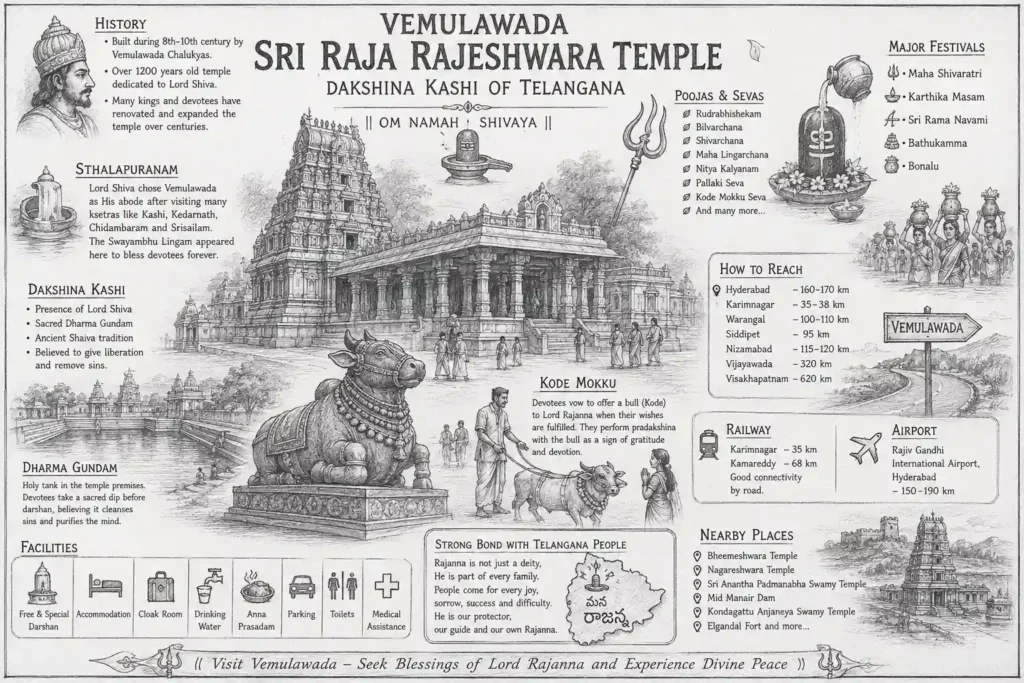
History of Vemulawada Sri Raja Rajeshwara Swamy Temple
The history of Vemulawada dates back more than 1,200 years. During the 8th to 10th centuries CE, Vemulawada served as the capital of the Vemulawada Chalukyas, a powerful dynasty that ruled large parts of present-day Telangana and neighbouring regions.
The Chalukya kings were great devotees of Lord Shiva. They built magnificent temples throughout their kingdom, with the Sri Raja Rajeshwara Temple becoming their most important spiritual center. The temple gradually grew into a famous pilgrimage destination, attracting saints, scholars, poets, and devotees from across India.
Over several centuries, many rulers renovated and expanded the temple complex. Even today, visitors can notice beautiful stone carvings, inscriptions, and traditional Dravidian architecture that reflect the craftsmanship of ancient India.
Why is Lord Shiva Worshipped Here as “Rajanna”?
The presiding deity is Sri Raja Rajeshwara Swamy, a sacred Shiva Lingam representing Lord Shiva in his supreme form.
However, devotees lovingly call Him “Rajanna.”
In Telangana, people share a very personal relationship with the deity. Instead of formally addressing Him as Raja Rajeshwara Swamy, devotees affectionately say:
- “Rajanna”
- “Mana Rajanna” (Our Rajanna)
- “Rajanna Deva”
This reflects the emotional connection between the people and the deity. Many families in Telangana have worshipped Rajanna for generations, considering Him their family protector.
The temple also houses shrines dedicated to:
- Sri Raja Rajeshwari Devi
- Sri Lakshmi Sahitha Siddhi Vinayaka
- Sri Anantha Padmanabha Swamy
- Sri Rama, Sita and Lakshmana
- Sri Anjaneya Swamy
- Several other deities within the temple complex.
The Sacred Sthalapuranam (Temple Legend)
Like many ancient Hindu temples, Vemulawada has a beautiful Sthalapuranam that explains the divine origin of the temple.
According to the legend, after blessing devotees at several sacred Shiva temples including Kashi, Kedarnath, Chidambaram, and Srisailam, Lord Shiva chose Vemulawada as His permanent abode to bless devotees in South India. Because of this belief, the temple came to be known as Dakshina Kashi, meaning the Kashi of the South.
Another popular belief states that the Shiva Lingam at Vemulawada is Swayambhu (self-manifested). It was not carved by humans but appeared naturally through divine power. Devotees believe this makes the temple especially powerful.
The Sthalapuranam also narrates that many sages performed penance at this sacred place. Pleased by their devotion, Lord Shiva appeared before them and promised to remain here forever to protect humanity and bless sincere devotees.
Because of this divine promise, people believe that prayers offered here are answered quickly, especially prayers for:
- Good health
- Marriage
- Children
- Success in education
- Peace of mind
- Relief from difficulties
This strong faith continues to attract millions of devotees every year.
Why is Vemulawada Known as “Dakshina Kashi”?
The title Dakshina Kashi means “Kashi of South India.”
There are several reasons why devotees compare Vemulawada with Kashi:
Presence of Lord Shiva
Just like Kashi is dedicated to Lord Vishwanath, Vemulawada is dedicated to Lord Raja Rajeshwara, another form of Shiva.
Holy Dharma Gundam
Pilgrims first take a sacred bath in Dharma Gundam, believing it cleanses sins before entering the temple for darshan.
Ancient Shaiva Tradition
For centuries, saints and devotees have considered Vemulawada one of the most sacred Shaivite pilgrimage centres in India.
Spiritual Liberation
Many devotees believe sincere worship at Vemulawada brings peace, prosperity, and spiritual upliftment.
Dharma Gundam – The Sacred Temple Tank
One of the most unique features of the temple is Dharma Gundam, the sacred temple tank located inside the temple premises.
Traditionally, devotees first take a holy dip in Dharma Gundam before entering the temple. This ritual symbolizes the purification of both the body and the mind.
The water is believed to possess sacred and healing properties. Though these beliefs are spiritual rather than scientific, devotees have followed this tradition for centuries with deep faith.
Temple Architecture
The Sri Raja Rajeshwara Temple beautifully reflects traditional Dravidian temple architecture.
Some of its notable architectural features include:
- A magnificent entrance gateway (Gopuram)
- Beautiful stone pillars with intricate carvings
- Ancient inscriptions from the Chalukya period
- Spacious temple courtyards
- Separate shrines for various Hindu deities
- Traditional mandapams used for rituals and festivals
The main sanctum houses the sacred Shiva Lingam, where devotees offer prayers, Bilva leaves, flowers, and Abhishekam.
The temple has undergone renovations over the centuries (Still Continuing) while preserving its ancient spiritual character, making it a remarkable blend of history, architecture, and devotion.
A Living Symbol of Telangana’s Heritage
The Sri Raja Rajeshwara Temple is much more than an ancient place of worship. It represents Telangana’s cultural identity, spiritual traditions, and historical legacy. From the era of the Vemulawada Chalukyas to the present day, the temple has remained a centre of faith, drawing millions of devotees who seek Lord Rajanna’s blessings with unwavering devotion.
Kode Mokku – The Most Unique Tradition of Vemulawada
One of the most famous and unique traditions of Vemulawada is Kode Mokku (also called Kode Mrokkubadi). This ritual has been followed for centuries and is one of the main reasons why devotees from Telangana visit the temple.
In this tradition, devotees make a vow (mokku) to Lord Rajanna when they pray for a wish such as good health, marriage, children, success in education, employment, or recovery from illness. Once their wish is fulfilled, they return to the temple to offer a bull (Kode), which is considered sacred because Nandi, the bull, is the divine vehicle of Lord Shiva.
After offering the bull, devotees perform Pradakshina (circumambulation) around the temple along with the animal before completing their prayers. This ritual symbolizes gratitude, devotion, and surrender to Lord Shiva. Unlike many temples, the tradition of Kode Mokku has become a unique cultural identity of Vemulawada and attracts thousands of devotees every year.
Kalyana Katta (Hair Offering)
The Kalyana Katta at Vemulawada Temple is a sacred place where devotees offer their hair to Lord Rajanna as an act of gratitude, humility, and devotion. Many pilgrims fulfil vows by tonsuring their heads, believing that surrendering their hair symbolizes letting go of ego and seeking the blessings of Lord Shiva for a blessed life.
Daily Poojas and Sevas
The temple follows traditional Shaiva Agama rituals every day. Devotees can participate in several poojas and sevas according to their faith and convenience.
Some of the important rituals include:
- Suprabhata Seva
- Mahanyasa Purvaka Rudrabhishekam
- Bilvarchana
- Shivarchana
- Maha Lingarchana
- Nitya Kalyanam
- Kumkuma Puja
- Pallaki Seva
- Maha Puja
- Satyanarayana Vratham
- Kode Mokku Seva
Many devotees also perform Abhishekam, offering milk, water, honey, curd, sandalwood paste, Bilva leaves, and flowers to the Shiva Lingam. Mondays, the holy month of Karthika, and Maha Shivaratri are considered especially auspicious for these rituals.
Major Festivals Celebrated
The temple celebrates many Hindu festivals with great devotion, but a few attract exceptionally large crowds.
Maha Shivaratri
Maha Shivaratri is the biggest festival of the temple. Lakhs of devotees gather to perform night-long prayers, Rudrabhishekam, and special darshan. The temple remains beautifully decorated with lights and flowers.
Sri Rama Navami
Since the temple complex also contains the shrine of Sri Sita Rama Chandra Swamy, Sri Rama Navami is celebrated with Kalyanotsavam and cultural programmes.
Karthika Masam
The entire month of Karthika is highly sacred for Shiva devotees. Thousands visit every Monday to perform Deepa Aradhana and special poojas.
Bathukamma and Bonalu
Being one of Telangana’s most important temples, Vemulawada also celebrates Bathukamma and Bonalu with great enthusiasm, reflecting the rich cultural traditions of the state.
How to Reach Vemulawada Temple
Vemulawada is well connected by road from all major cities in Telangana and neighbouring states.
| City | Approximate Distance |
| Hyderabad | 160–170 km |
| Karimnagar | 35–38 km |
| Warangal | 100–110 km |
| Siddipet | 95 km |
| Nizamabad | 115–120 km |
| Kamareddy | 70 km |
| Vijayawada | 320 km |
| Visakhapatnam | 620 km |
Travel time from Hyderabad is usually 3.5 to 4 hours by road. Regular TSRTC buses, private buses, taxis, and self-drive vehicles make the journey convenient.
Nearest Railway Stations
The temple can be reached through several nearby railway stations.
- Karimnagar Railway Station – about 35 km
- Kamareddy Railway Station – about 68 km
- Sircilla Railway connectivity is improving through the regional rail network.
From these stations, taxis, buses, and auto-rickshaws are easily available to reach the temple.
Nearest Airport
The nearest airport is:
- Rajiv Gandhi International Airport, Hyderabad – approximately 150–190 km, depending on the route.
The airport has direct flights from all major Indian cities and several international destinations. Visitors can hire taxis or board TSRTC buses from Hyderabad to reach Vemulawada comfortably.
Facilities Available for Pilgrims
The temple administration provides several facilities to ensure a comfortable pilgrimage experience.
Some of the important facilities include:
- Free Darshan
- Special Darshan and Seva tickets
- Temple accommodation and dormitories
- Cloakroom for luggage
- Parking facilities
- Drinking water
- Anna Prasadam and canteen
- Clean bathing ghats near Dharma Gundam
- Separate changing rooms for women
- Toilets and sanitation facilities
- Medical assistance
- Prasadam counters
- Temple information centre
These facilities make it convenient for devotees visiting with families, elderly people, and children.
The Strong Bond Between Vemulawada Rajanna and the People of Telangana
Very few temples enjoy the emotional connection that Vemulawada shares with the people of Telangana.
For many families, Lord Rajanna is not just a deity but a member of the family. Parents often bring newborn babies to the temple for blessings. Students visit before examinations. Farmers pray before the agricultural season. Newly married couples seek divine blessings, and families return after achieving success to fulfil their vows.
Many Telugu names such as Rajanna, Rajeshwar, Rajeshwari, and Rajanna Swamy reflect this deep devotion.
During Maha Shivaratri and Karthika Masam, devotees walk long distances carrying offerings, singing devotional songs, and chanting “Om Namah Shivaya.” This living tradition has continued for generations and remains an important part of Telangana’s cultural identity.
Vemulawada is not only a pilgrimage centre but also a symbol of faith, unity, and the spiritual heritage of Telangana.
Nearby Places to Visit
If you are planning a trip to Vemulawada, you can also visit:
- Bheemeshwara Temple
- Nagareshwara Temple
- Sri Anantha Padmanabha Swamy Temple
- Sri Sita Rama Chandra Swamy Temple
- Pochamma Temple
- Mid Manair Dam
- Lower Manair Dam (Karimnagar)
- Elgandal Fort
- Kondagattu Anjaneya Swamy Temple
These attractions can easily be covered during a one- or two-day trip.
Best Time to Visit
Although the temple is open throughout the year, the best time to visit is from October to March, when the weather is pleasant.
The most spiritually vibrant occasions are:
- Maha Shivaratri
- Karthika Masam
- Shravana Mondays
- Sri Rama Navami
- Dasara
- Bathukamma
Visiting early in the morning allows devotees to enjoy peaceful darshan with shorter waiting times.
Travel Tips for Devotees
- Wear traditional and modest clothing.
- Carry drinking water during summer.
- Reach early during festivals to avoid long queues.
- Keep footwear only at designated counters.
- Follow temple rules and photography restrictions.
- Book accommodation in advance during Maha Shivaratri and Karthika Masam.
- Respect temple traditions and maintain cleanliness.
Frequently Asked Questions (FAQs)
Why is Vemulawada Temple famous?
The temple is famous for Lord Shiva as Sri Raja Rajeshwara Swamy (Rajanna), the sacred Dharma Gundam, and the unique Kode Mokku ritual.
Why is it called Dakshina Kashi?
Because devotees believe worshipping Lord Shiva here brings spiritual merit similar to visiting Kashi in North India.
What is Kode Mokku?
Kode Mokku is a sacred vow in which devotees offer a bull to Lord Shiva after their wishes are fulfilled and perform pradakshina around the temple.
Which is the nearest railway station?
Karimnagar Railway Station is the nearest major railway station, located about 35 km away.
Which is the nearest airport?
Rajiv Gandhi International Airport in Hyderabad is the nearest airport.
Is accommodation available?
Yes. The temple provides guest houses, dormitories, and several private hotels and lodges are available nearby.
Gyanavedam Categories :
Analytical Articles | Children’s Stories | Education – Building Knowledge | History and Heritage | Indian Temples and Sacred Places | Knowledge & Facts | Do You Know | Sanathana Dharma | Videos & YouTube Channel
Official Website | Youtube Video of Temple