Arupadai Veedu The Six Sacred Abodes of Lord Murugan That Together Form the Sacred Symbol OM
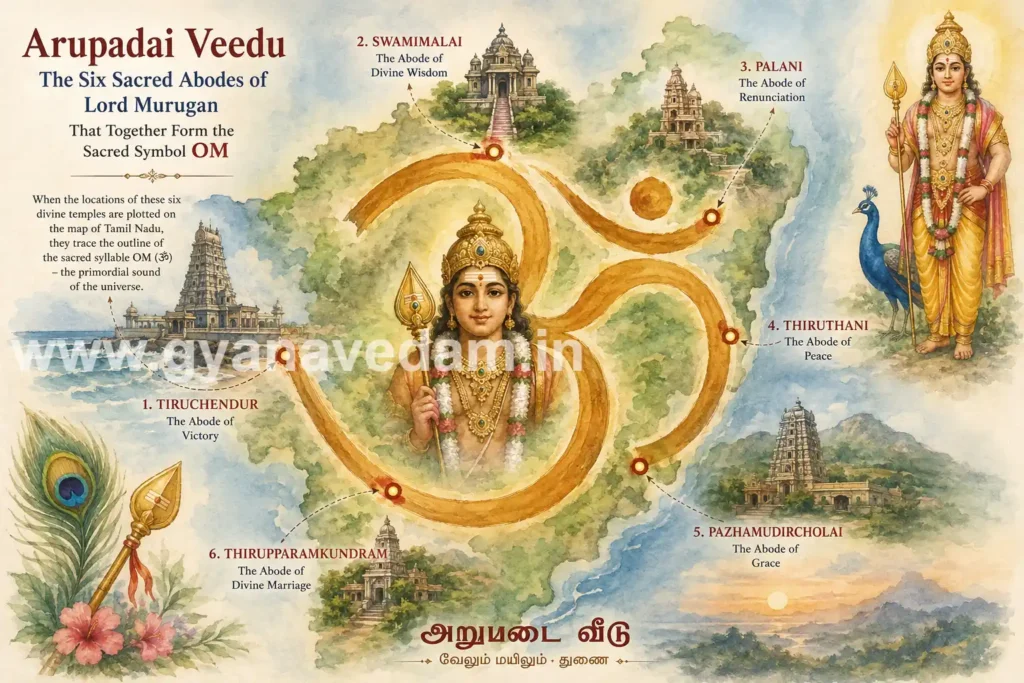
Scattered across the verdant landscape of Tamil Nadu — from a sunlit seashore to forested hillocks draped in mist — six sacred temples stand as the most hallowed addresses of Lord Murugan, the eternal war commander of the gods. Known collectively as the Arupadai Veedu (அறுபடை வீடு), meaning “Six Battle Abodes,” these shrines mark the divine stations where Murugan — also revered as Subramanya Swami, Kartikeya, Skanda, and Kanda — waged his cosmic war, taught the highest wisdom, and found his peace. What makes this circuit even more extraordinary is a revelation that has awed devotees and scholars alike: when the geographical locations of these six temples are plotted on a map of Tamil Nadu, they trace the outline of the sacred syllable OM (ॐ) — the primordial sound of the universe itself.
This is not coincidence. This is the divine geometry of Sanatan Dharma.
The Skanda Purana and the Birth of a God
Before stepping into each temple, one must understand why Murugan was born at all. The Skanda Purana, one of the eighteen major Puranas of Sanatan Dharma, narrates that the demon brothers Surapadman, Simhamukhan, and Tarakasuran performed severe penance and obtained near-immortality from Lord Shiva — a boon stating they could only be killed by Shiva’s own son. Drunk with power, they enslaved the Devas and plunged the three worlds into darkness. The gods, desperate, appealed to Lord Vishnu and Brahma, who in turn invoked Shiva. From Shiva’s third eye, six sparks of fire were born — the Shad Jyotis — which the Goddess Ganga carried to the Saravana lake in the Himalayas. The divine infant Murugan was born with six faces (Shanmukha) and twelve arms, nursed by the six Krittika stars. He grew swiftly into the supreme commander and proceeded to vanquish the asuras across several legendary battlefields — each of which became one of the six sacred Arupadai Veedu temples. The Tirumurukāṟṟuppaṭai, a Sangam-era text by the poet Nakkeerar (dated to the 1st–3rd century CE), is the earliest literary reference to all six abodes, guiding devotees on this sacred path across Tamil Nadu.
1. Thiruparankundram — Where Victory Becomes a Wedding (8 km from Madurai)
The pilgrimage begins at Thiruparankundram, a magnificent rock-cut cave temple carved into a granite hill on the outskirts of Madurai. This is the first Padai Veedu and represents victory and divine union. After the great battle in which Murugan slew Surapadman, Lord Indra offered his daughter Deivanai (Devasena) in gratitude, and the celestial wedding took place here. The sthalapuranam notes this as the spot where the gods themselves celebrated. The temple also holds the unique distinction of being the only one among the six where Abhishekam (ritual bathing) is performed for the Vel (divine spear) rather than for the idol of Murugan — a practice rooted in the belief that the Vel is Murugan’s own supreme power. The Sangam poet Nakkeerar composed his famous Tirumurukāṟṟuppaṭai here.
Nearby temples: The magnificent Meenakshi Amman Temple (Madurai, 8 km) and the ancient Koodal Azhagar Vishnu temple (Madurai) are sacred companions on this leg of the yatra.
2. Tiruchendur — The Shore of Cosmic Triumph (180 km from Thiruparankundram)
Standing with its feet washed by the Bay of Bengal, Tiruchendur is the only Arupadai Veedu temple built by the seashore — and uniquely, it is the only one where Murugan pitched his camp with his divine army before confronting Surapadman. The Skanda Purana details how the demon king, cornered at last, transformed into a massive mango tree that spread across the three worlds. Murugan hurled his divine Vel, splitting the tree in two — one half became his peacock vahana and the other became the rooster on his flag. The Soorasamharam festival reenacted here every year during Kanda Sashti draws hundreds of thousands of devotees. The temple is also known as Arulmigu Subramaniya Swami Temple, and its coastal location gives it an ethereal beauty at dawn and dusk, when the sound of the sea mingles with temple bells.
Nearby temples: The Suchindram Thanumalayan Temple (75 km south, near Kanyakumari) — a unique shrine dedicated to the Trimurthis — is a revered stop for pilgrims visiting Tiruchendur.
3. Palani — The Hermit God on the Hill (220 km from Tiruchendur)
If Tiruchendur is the warrior’s victory, Palani is the philosopher’s renunciation. When sage Narada brought Shiva a Gnana palam (fruit of wisdom), it was decided that whichever son first circled the world three times would receive it. While Murugan mounted his peacock and raced around the globe, Ganesha circumambulated their parents Shiva and Parvati — arguing that parents are the entire universe. Ganesha won. Furious and heartbroken, Murugan stripped himself of his divine ornaments, discarded his vel, and climbed the Palani hills to live as an ascetic. He declared: “Pazham nee appa, naan palam” — “You are the fruit, father, and I am the seed.” This profound statement defines the temple’s spiritual character.
The idol here — Dhandayuthapani Swamy — is one of the most remarkable in the world. It was sculpted by the Tamil Siddha saint Bhogar from a compound of nine herbs and nine poisons (Navapashanam), a formula that, legend says, also functions as medicine. The Panchamirtham prasad (a sacred mixture of five natural ingredients) offered here is world-renowned and carries a GI tag. The temple is accessible by ropeway, winch, or the traditional 693-step climb.
Nearby temples: Arulmigu Thiruavinankudi Temple at the foot of Palani Hill houses Murugan as Kuzhanthai (child form), and Adi Vinayagar Temple near Dindigul is considered directly related to this abode.
4. Swamimalai — The Son Who Taught His Father OM (100 km from Palani)
Located just 5 km from Kumbakonam, Swamimalai is perhaps the most philosophically profound of all six abodes. The Skanda Purana narrates that when Lord Brahma was once unable to correctly explain the meaning of the Pranava Mantra (OM) to Murugan, the young god imprisoned him — demonstrating that he alone held the full knowledge of the sacred syllable. Later, Murugan sat Shiva down as a student and expounded the infinite meaning of OM to his own father. This inversion — son teaching father — is why Murugan is here worshipped as Swaminatha Swami (the Lord who is his own master’s master) and the temple is reverentially called Gurumalai.
The 60 steps leading to the temple represent the 60 Tamil years (years in the Hindu cycle). The idol of Murugan here is uniquely carried on Airavata (Indra’s elephant) rather than the peacock — symbolising knowledge over war. Swamimalai is also globally renowned as a centre of Panchaloha bronze casting, producing the finest Chola-style divine statues.
Nearby temples: The Brihadeeswarar Temple at Thanjavur (40 km), a UNESCO World Heritage Site, and the Sarangapani Temple at Kumbakonam are magnificent companions to this abode.
5. Thiruthani — Where the Warrior Found Peace (310 km from Swamimalai)
After the great battle, even a victorious warrior needs healing. Thiruthani — perched 700 feet above sea level, about 75 km from Chennai — is where Murugan came to rest and recover his serenity. The 365 steps leading to the temple represent every day of the year, a reminder that one’s journey toward the divine is lifelong and daily. It was also near Thiruthani that Murugan, disguised as an old hunter, won the love of Valli, a tribal girl who became his second divine consort — a story of love, disguise, and Ganesha’s comic assistance that Tamil literature has celebrated for centuries.
The temple is also located on the border region of Tamil Nadu and Andhra Pradesh, making it an important shrine for both Tamil and Telugu communities.
Nearby temples: The Tirupati Venkateswara Temple (80 km) is the grandest pilgrimage destination near Thiruthani. Many devotees take the blessings of both Murugan and Venkateswara in one journey.
6. Pazhamudircholai — Love in the Forest with Both Consorts (20 km from Madurai)
The pilgrimage comes full circle near Madurai, at the lush forested hills of Pazhamudircholai — “the grove of fresh fruits” — rising from Solaimalai hill. This is the only Arupadai Veedu temple where Murugan is worshipped alongside both his consorts, Valli and Deivanai, together — representing the completion of his divine love story. A sacred stream called Nupura Gangai flows nearby, adding to its natural sanctity. The forest setting makes this temple the most nature-immersed of the six, connecting to Murugan’s ancient role as the Kurinji (mountain) deity — lord of hills, forests, and young love described in Sangam literature.
The sthalapuranam here is closely tied to the Madurai Meenakshi tradition, as Parvati (as Meenakshi) is seen as the divine mother who blessed this grove. The Vel worshipped at Pazhamudircholai is known as Kurinji Nilam Kizhavan — the lord of the mountain domain.
Nearby temples: Madurai Meenakshi Amman Temple (20 km) and Thiruparankundram complete a sacred Madurai triangle with Pazhamudircholai.
The OM Connection — Divine Cartography
When devotees and geographers plot the exact coordinates of the six Arupadai Veedu temples on a Tamil Nadu map and connect them in traditional pilgrimage order, the resulting path traces a shape strikingly similar to the sacred symbol OM (ॐ). Thiruparankundram and Pazhamudircholai anchor the base near Madurai, Tiruchendur curves south along the coast, Palani rises to the northwest, Swamimalai forms the middle sweep near Kumbakonam, and Thiruttani reaches toward the northeast — completing the cosmic arc. This geographical OM is interpreted by devotees as Murugan’s own signature inscribed across the Tamil land — an echo of Swamimalai’s legend, where Murugan himself revealed the meaning of this primordial sound to Shiva.
The Pilgrimage Route at a Glance
| Temple | Location | Distance from Previous Temple |
| Thiruparankundram | 8 km from Madurai | Starting point |
| Tiruchendur | Thoothukudi District | ~180 km |
| Palani | Dindigul District | ~220 km |
| Swamimalai | 5 km from Kumbakonam | ~100 km |
| Thiruthani | 75 km from Chennai | ~310 km |
| Pazhamudircholai | 20 km from Madurai | ~180 km |
Best time to visit: November to April | Total yatra distance: ~1,000 km
The Living Spiritual Legacy
The Arupadai Veedu temples are documented in Tirumurukāṟṟuppaṭai by Nakkeerar (1st century CE), in the Thiruppugazh by Saint Arunagirinathar (15th century CE), and in the Kanda Puranam — the Tamil retelling of the Skanda Purana. These texts have guided devotees across 2,000 years of living pilgrimage. The abodes are also understood symbolically: the six temples represent the inner victory over the six enemies of the human soul — desire (kama), anger (krodha), greed (lobha), attachment (moha), pride (mada), and jealousy (matsara) — the very asuras within us that Murugan the eternal warrior comes to slay.
To visit the Arupadai Veedu is not merely to travel across Tamil Nadu. It is to walk the arc of a god’s life — from triumph and marriage to renunciation, wisdom, love, and peace — and to find, in the sacred geometry of this journey, the sound of OM reverberating beneath every step.
Vel Vel Vetrivel! Hara Hara Muruganey! 🙏
Festivals to plan your visit around: Kanda Sashti (Tiruchendur, Oct–Nov), Thaipusam (Jan–Feb), Vaikasi Visakam (May–June), Panguni Uthiram (March–April)
Gyanavedam Categories :
Analytical Articles | Children’s Stories | Education – Building Knowledge | History and Heritage | Indian Temples and Sacred Places | Knowledge & Facts | Do You Know | Sanathana Dharma | Videos & YouTube Channel