
Whale Fall The Deep Sea Afterlife
Whale Fall The Deep Sea Afterlife : The Ecological Epic of a Whale Fall
When a blue whale (Balaenoptera musculus) breathes its last breath at the ocean’s surface, it doesn’t just disappear. It begins a final, downward journey that will fuel one of the most complex and long-lasting successional ecosystems on Earth. In the barren, nutrient-poor desert of the deep ocean floor, a single whale carcass provides a concentrated “pulse” of energy equivalent to 2,000 years of “marine snow” (the constant drizzle of organic detritus) falling on that same area.
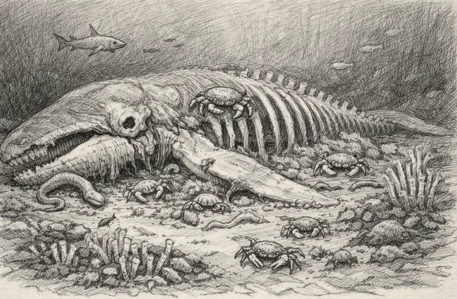
This process, known as a whale fall, progresses through four distinct stages, each supporting a unique cast of deep-sea characters.
Stage 1: The Mobile Scavenger Phase (Months to 2 Years)
The first responders are the “heavy hitters” of the deep. When the carcass hits the seafloor, the scent of decaying flesh travels for miles through the water column.
- The Predators: Sleeper sharks, hagfish, and giant amphipods arrive first. Hagfish are particularly specialized; they lack jaws but use rasping tongues to burrow into the soft tissue, eating the whale from the inside out.
- The Feast: During this stage, scavengers can strip up to 40–60 kilograms (roughly 90–130 lbs) of soft tissue per day. For a 200-ton blue whale, this feast can last up to two years, supporting thousands of organisms.
Stage 2: The Enrichment-Opportunist Phase (Months to 3 Years)
Once the large chunks of meat are gone, the “scraps” remain. The sediment surrounding the whale becomes highly enriched with organic matter, turning the immediate area into a biological hotspot.
- The Colonizers: Small crustaceans, polychaete worms, and mollusks (like the snails and limpets) blanket the bones and the nearby seabed.
- Population Explosion: The sheer density of life in this stage is staggering. Researchers have found up to 40,000 animals per square meter during this phase—some of the highest concentrations of marine life ever recorded.
Stage 3: The Sulfophilic (Sulfur-Loving) Phase (Decades)
This is perhaps the most scientifically “weird” stage. Once the tissue is gone, most animals would see only bare bone. However, whale bones are up to 60% fat (lipids) by weight. To get to that energy, a complex chemical process must occur.
The Rise of the Zombie Worms
The “zombie worms” (Osedax). These creatures have no mouth or stomach. Instead, they use “roots” that penetrate the bone, utilizing symbiotic bacteria to digest the fats and oils trapped inside the calcium matrix.
Chemosynthesis
As bacteria break down the lipids inside the bones, they produce hydrogen sulfide ($H_2S$). In a process similar to what happens at hydrothermal vents, specialized bacteria use this sulfur as an energy source (chemosynthesis). This supports a massive community of:
- Mussels and clams that house sulfur-oxidizing bacteria in their gills.
- Thick mats of white bacteria that look like “shag carpeting” over the skeleton.
Stage 4: The Reef Phase (Indefinite)
After 50 to 100 years, the organic nutrients are finally exhausted. What remains is a mineral-rich skeleton. At this point, the whale fall acts as a hard-substrate reef.
In the soft, muddy desert of the deep sea, a hard surface is a premium commodity. The bones provide a home for filter feeders like sponges, sea fans, and cold-water corals. The “footprint” of the whale remains a landmark on the seafloor long after its biological energy has been recycled into the ocean’s food web.
Comparison: Land vs. Sea
The image you provided shows a whale carcass on King George Island. As the caption notes, this transformation is very different from those on the ocean floor.
- On Land: Scavenging is faster due to oxygen availability and birds (like petrels or skuas). The nutrients leach into the soil, often creating “verdant zones” of lush grass in the Antarctic tundra.
- At Sea: The high pressure and low temperature of the deep ocean slow down decomposition, allowing the “sulfophilic” stage to last for a century.
Why Whale Falls Matter
Whale falls are essential for marine biodiversity. Scientists believe they act as “stepping stones” for species to migrate across the ocean floor. A species might travel from one whale fall to another, eventually reaching a hydrothermal vent or a cold seep.
By dying, the blue whale—the largest animal to ever live—continues its legacy as a literal “life-giver” for organisms that will never see the sun.
Gyanavedam Categories :
Analytical Articles | Children’s Stories | Education – Building Knowledge | History and Heritage | Indian Temples and Sacred Places
Knowledge & Facts | Do You Know | Sanathana Dharma | Videos & YouTube Channel
