
AKSHAYA TRITIYA — THE FESTIVAL OF ETERNAL PROSPERITY
What Is Akshaya Tritiya?
Akshaya Tritiya is a festival in Hindu and Jain traditions, observed during the Hindu calendar month of Vaishakha, which falls in April or May. It is celebrated on the third lunar day (Tritiya) of the fortnight of the waxing moon (Shukla Paksha). The word “Akshaya” means “imperishable” or “eternal,” signifying success and good fortune.
The word “Akshaya” in this festival means that which never decays — that which lasts forever, that which is infinite. This is why chanting, penance, charity, service, havan, or any auspicious work done on this day is considered to yield eternal fruits.
Also known as Akha Teej or Kati, Akshaya Tritiya is the third day of the Vaisakh month, the second month in the Hindu calendar. In parts of Rajasthan and Gujarat, it is popularly called Akha Teej, while in Odisha and parts of central India, it is referred to as Akti. Despite the varying names across regions, the core belief remains the same: this is a day when anything begun, gifted, or donated will grow endlessly without diminishing.
The word Akshaya means “never diminishing.” Hence the benefits of doing any Japa, Yajna, Pitra-Tarpan, or Dan-Punya on this day never diminish and remain with the person forever. The festival is revered equally by Hindus and Jains, though each tradition brings its own stories and customs to the occasion.
The Significance of Akshaya Tritiya
The significance of Akshaya Tritiya is multi-layered. It operates on religious, astrological, agricultural, and cultural levels simultaneously, making it one of the most complete festival days in the Indian calendar.
Astrological Significance
In classical Jyotisha, the Sun represents the soul, inner strength, and life energy, while the Moon signifies the mind and emotions. On Akshaya Tritiya 2026, the Sun is in Aries (Mesha), its strongest position, meaning power and positive energy are at their highest. At the same time, the Moon is in Taurus (Vrishabha), where emotional balance and stability are at their best. When both the Sun and Moon are strong, the moment is considered powerful and is known as a Swayam Siddha Muhurta.
This rare dual planetary alignment is what distinguishes Akshaya Tritiya from ordinary auspicious days. Most auspicious occasions require a priest to identify a specific muhurta (auspicious window of time) using the almanac. Vedic astrologers consider Akshaya Tritiya an auspicious day free from all malefic effects. As per Hindu Electional Astrology, three lunar days — Yugadi, Akshaya Tritiya, and Vijay Dashami — do not need any Muhurta to start or perform any auspicious work, as these three days are free from all malefic effects.
Akhatrij is one among those days that are considered as Sadhe Teen Shubh Muhurat — three and a half auspicious days — of the year. This is an exceptional honour in the Hindu calendar, placing Akshaya Tritiya among just a handful of days in an entire year considered unconditionally auspicious from sunrise to sunset.
Agricultural Significance
In many parts of rural India, Akshaya Tritiya marks the beginning of the agricultural cycle. In the eastern regions of India, Akshaya Tritiya heralds the commencement of the agricultural season’s first ploughing. The occasion is marked with festivities as farmers seek divine blessings for a prosperous harvest. In Odisha especially, farmers perform rituals in the fields and seek blessings for the crop cycle. The sowing of seeds on this day is believed to guarantee fruitful harvests — a deeply practical tradition woven into a spiritual framework.
Religious Significance
Akshaya Tritiya is a highly auspicious Hindu festival that signifies eternal prosperity, success, and divine blessings. This day is believed to be free from all planetary doshas, making it ideal for new beginnings, charity, spiritual practices, and investment in gold or property.
It is also the day when the gates of Char Dham of Uttarakhand are opened for darshan. The Chardham temples close in November because of heavy snowfall and inaccessibility in winter. After the long wait of six months, Chardham temples open on the date of Akshaya Tritiya every year. This tradition of opening the Char Dham shrines on Akshaya Tritiya has been followed for centuries, as the lunar phase on Akshaya Tritiya is considered favorable for religious journeys.
Mythological Stories Associated with Akshaya Tritiya
No Indian festival is complete without mythology, and Akshaya Tritiya is extraordinarily rich in sacred stories from multiple traditions.
The Story of Sudama and Krishna
Akshaya Tritiya is the day when Lord Krishna’s poor friend Sudama offered him rice and in return got blessed with wealth by Krishna. Sudama, a childhood companion of Krishna, had fallen into deep poverty. Ashamed of his circumstances, he visited Krishna with only a small bundle of flattened rice (poha) as a gift. Without Sudama asking for anything, Krishna’s divine grace transformed his humble hut into a palace overflowing with riches upon his return. This story perfectly encapsulates the spirit of Akshaya Tritiya — that what is given with a pure heart returns multiplied a thousandfold.
The Akshaya Patra of the Pandavas
There is a story associated with Akshaya Tritiya about the Akshaya Patra given to the Pandavas during their exile in the Mahabharata. When Draupadi prayed to Lord Krishna, worried about feeding many sages and guests, he blessed the Pandavas with a special vessel that would provide unlimited food until she finished her own meal. This magical vessel, the Akshaya Patra, became a symbol of abundance that never exhausts — perfectly mirroring the day’s meaning. The vessel is said to have been given to the Pandavas precisely on Akshaya Tritiya, making the connection between this day and boundless sustenance an enduring one.
The Mahabharata Begins
The mythology of Akshaya Tritiya states that Lord Ganesh started writing the Hindu epic Mahabharata, which was narrated by sage Ved Vyas. On this day, sage Vyasa began dictating the epic to the Hindu deity Ganesha, who wrote it down, acting as a scribe. The idea that the world’s longest epic poem — a work that has never diminished in relevance across thousands of years — was begun on Akshaya Tritiya gives the day an intellectual and literary dimension that goes beyond material prosperity.
Parashurama Jayanti
Akshaya Tritiya is also believed to be the birthday of Parashurama, the sixth avatar of Vishnu, who came to restore justice and cosmic balance through right action. Many devotees, especially in North India, celebrate Akshaya Tritiya simultaneously as Parashurama Jayanti. The avatar Parashurama is associated with discipline, valor, and the restoration of cosmic order — qualities that also embody the spirit of new, righteous beginnings.
Descent of the Sacred Ganga
On this day the Ganges River, regarded as sacred in Hinduism, descended from svarga to earth, making the day significant for ritual baths in rivers and offering prayers for purification and blessings. This event is celebrated particularly in North India, where pilgrims take holy dips in the Ganga on Akshaya Tritiya morning.
Kubera’s Divine Appointment
According to some Hindu narratives, on this day Kubera, known as the god of wealth, was appointed the treasurer of heaven by Shiva. Because of this association with Kubera, celebrants seek blessings for wealth and abundance on Akshaya Tritiya. On the day of Akshaya Tritiya, Kubera was appointed as the divine treasurer. Thus, any valuable item bought on this day never diminishes and continues to grow.
Indra’s Redemption
The Skanda Purana describes Akshaya Tritiya as a day of divine blessings. It narrates how Indra, the king of the gods, fled to Mount Meru, ashamed for having slept with a sage’s wife and in fear of the sage’s curse. As a result of his misdeed, he lost his strength and status. While Indra hid in a cave, the daityas (demons) took over heaven. The gods, desperate for Indra’s return, sought help from Brihaspati. Following Brihaspati’s advice, Indra performed rituals and charitable acts on Akshaya Tritiya, after which he regained his divine power, defeated the daityas, and restored order in heaven. This story establishes Akshaya Tritiya as not just a day for accumulation, but a day for redemption, purification, and the restoration of righteousness.
The Jain Significance — Varshi Tapa
Akshaya Tritiya is also a significant day in the Jain religion. According to Jain beliefs, the First Tirthankara Rishabha, also known as Aadinath and Rishabhdev, ended their one-year long asceticism and fast by drinking sugarcane juice. The day of Akshaya Tritiya is called Varshi Tapa by some Jains. This event holds enormous religious importance for the Jain community. A popular food item for this day is sugarcane, and its juice is highly sought after for this particular event. Jain households across India mark the day with special prayers, processions, and charitable activity, particularly donations of food and essentials to the needy.
The Yugadi Transition
According to Hindu time calculations, Akshaya Tritiya marked the end of Satya Yuga and the beginning of Treta Yuga. The Satya Yuga was the golden age of truth and righteousness, and Treta Yuga represented the next phase of cosmic time. This epic cosmic transition happening on Akshaya Tritiya places the festival at the intersection of two world cycles, adding an almost incomprehensible sense of scale and significance to the day.
How Is Akshaya Tritiya Celebrated?
The celebrations of Akshaya Tritiya are beautifully diverse across India’s regions, though the spiritual core remains consistent.
Morning Rituals
Devotees wake up before sunrise to perform ritual cleansing or bathe in sacred rivers such as the Ganga. Early morning prayers, lamp lighting (deepa), and the preparation of offerings begin the day in most households. The home altar is cleaned, flowers are arranged, and rice, turmeric, and sweets are offered to Vishnu and Lakshmi idols.
Puja and Worship
Lord Vishnu is the primary deity worshipped on Akshaya Tritiya. On this day, Kuber is also worshipped. Those who bathe before midday and perform Japa, Tapa, Homa, Yajna, study of scriptures, Pitru-Tarpan, and donations receive tremendous auspicious results. Many families perform a full Lakshmi-Narayana Puja at home or visit temples in the morning and evening.
Charity and Donations
Donation of food is called “Annadanam Param Daanam” — food is the Supreme Being — in religious texts. Feeding a hungry person on Akshaya Tritiya is considered equivalent to serving Lord Narayana himself. Due to the onset of summer, donating sattu, jaggery, and cool water on this day holds special significance. Donating water in an earthen pot (kumbha) on this day satisfies the souls of ancestors.
Regional Celebrations
The diversity of Akshaya Tritiya shines in its regional expressions. North Indians take a dip in the holy waters of the river Ganga to prepare for the celebration of the birth of Sage Parashurama. The Rajasthanis indulge in kite flying competitions. The Bengalis start their new Halkhatas (audit books). The Odiyas begin the construction of the chariot for Rathayatra. The South Indians perform the Maha Vishnu Puja.
In South India, Tamil Nadu and Andhra Pradesh families visit temples and buy traditional gold jewellery and coins for blessings. Special delicacies are prepared, such as mango pachadi and sweets. In Gujarat and Maharashtra, households observe Lakshmi Pujan, and they donate food or grains in donations. Their prominent tradition is purchasing gold bangles or necklaces.
Unknown and Lesser-Known Facts About Akshaya Tritiya
While the mainstream traditions of gold buying and Lakshmi worship are widely known, several fascinating facts about Akshaya Tritiya remain under the radar.
It Has More Than One Name
Across India’s linguistic landscape, Akshaya Tritiya is known by at least five different names — Akha Teej, Akti, Akti Teej, Varshi Tapa (in Jainism), and Atchaya Thiruthi (in Tamil). Each name reflects the same essential meaning: the day of indestructibility.
It Is One of Only Three and a Half Swayam Siddha Muhurtas
Akhatrij is one among those days that are considered as Sadhe Teen Shubh Muhurat (three and a half auspicious days) of the year. This makes it profoundly rare. In the entire 365-day Hindu calendar year, only three and a half days are universally considered auspicious without needing additional calculation. The others are Gudi Padwa (Hindu New Year), Vijay Dashami (Dussehra), and half of Diwali. Akshaya Tritiya stands fully among them.
The Rath Yatra Connection
An extraordinary and little-known fact is that in Odisha, the massive logs for the chariots used in the famous Rath Yatra of Puri — one of the largest religious processions in the world — are ceremonially cut and the chariot construction begins on Akshaya Tritiya. This makes the day not merely a beginning for individuals, but for one of India’s most spectacular annual spectacles.
It Falls Differently Every Year
Unlike fixed-date festivals such as Christmas or Republic Day, Akshaya Tritiya follows the lunar calendar and therefore falls on a different Gregorian date each year. It can fall anywhere between mid-April and mid-May. Akshaya Tritiya is especially auspicious when it falls on a Wednesday or Monday, combined with the Rohini Nakshatra, as its auspiciousness increases immensely.
Multiple Deities Are Born or Blessed on This Day
Depending on the sacred text consulted, Akshaya Tritiya is associated with an extraordinary number of divine events: the birth of Parashurama, the descent of Ganga, the appointment of Kubera, the birth of Goddess Annapurna, the beginning of the Mahabharata, and the transition from Satya Yuga to Treta Yuga — all said to have occurred on this single day. No other festival in the Indian calendar carries such a concentration of mythological events.
Pitru Tarpan Has Eternal Value on This Day
Many Hindus perform Pitru Tarpan — offerings of water and sesame seeds to ancestors — on Akshaya Tritiya. The benefits of doing Pitru-Tarpan on this day never diminish and remain with the person forever. In many families, this ancestor-remembrance ritual is considered even more important than gold purchases, though it rarely gets media attention.
The Vrat Katha of the Pious Poor Man
In ancient times, there was a poor and virtuous man who, in poverty, was suggested about Akshaya Tritiya Vrat. He performed this fast ritualistically — waking up early in the morning, bathing in the Ganga river, worshipping the Gods, and giving donations. This man became the King of Kushavati in his next birth. Thanks to the effects of those Akshaya Tritiya rituals, he became quite mighty and rich. This story from the Puranas is recited by priests and grandmothers alike to emphasise that the merit of this day transcends material boundaries — even one born in poverty can transform his destiny through righteous observance.
Date and Timings in 2026
According to the Gregorian calendar, Akshaya Tritiya will be on April 19, 2026. The day of Akshaya Tritiya will begin at 05:31 PM on April 18, 2026, and will end at 02:12 PM on April 19, 2026.
The Tritiya Tithi begins at 10:49 AM on April 19 and ends at 7:27 AM on April 20, 2026. The Akshaya Tritiya Pooja Muhurat is from 10:49 AM to 12:21 PM, a highly divine window lasting 1 hour and 33 minutes.
The auspicious time for purchasing gold on this day is considered particularly powerful, from 10:49 AM on April 19 to 6:14 AM on April 20.
In 2026, Akshaya Tritiya falls on a Sunday, which is considered favourable since it allows entire families — including working members — to participate fully in the rituals, temple visits, and celebrations without the constraint of a working day.
Gold Purchases: The Tradition, the Hype, and the Numbers
Why Gold?
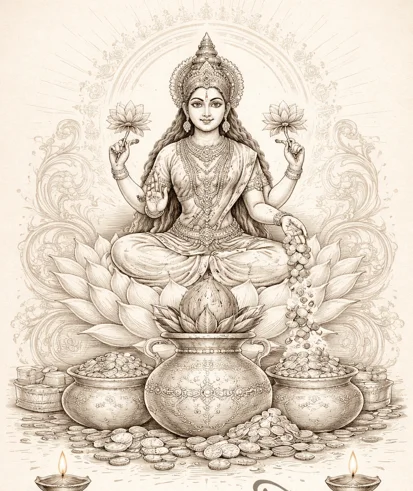
In Hindu tradition, gold is strongly connected with Goddess Lakshmi, who represents wealth, abundance, and good fortune. She is shown sitting on a golden lotus, symbolising that prosperity comes from purity and spiritual goodness. As Akshaya Tritiya is considered an auspicious day to seek the blessings of Lord Vishnu and Goddess Lakshmi, buying gold is seen as a way of welcoming prosperity into the home.
According to legends, Kubera, the god of wealth, worshipped Goddess Lakshmi on Akshaya Tritiya and was blessed with immense riches. Hence, buying gold is seen to seek the goddess’s blessings. Gold has been a trusted investment for generations.
The Scale of Gold Buying
The total gold volume sales touch the year’s peak all over the country on Akshaya Tritiya. The scale is staggering. Akshaya Tritiya is expected to rake in approximately ₹16,000 crore in business on a single day. Southern India accounts for 40% of the country’s Akshaya Tritiya gold demand, followed by the western region at 25%, eastern at 20%, and northern at 10%. The south’s dominance in this tradition reflects its deep-rooted cultural identification with gold as both a spiritual and economic asset.
Gold Prices: The Rising Tide
Gold prices have surged dramatically. From 2019 to 2025, that represents a 209% gain. In just one year from Akshaya Tritiya 2024 to 2025, the price of gold increased by more than 30%. In 2025 alone, gold gained around 23%, or approximately ₹18,000 per 10 grams.
This year marks a significant period for gold, with global prices increasing by 25% since January and reaching a record high of $3,500 per ounce. In India, gold prices hit historic highs of Rs. 1 lakh per 10 grams.
Looking ahead to Akshaya Tritiya 2026, analysts project that gold could reach $3,600–$3,700 per ounce, or ₹1,01,000–₹1,04,000 per 10 grams by Akshaya Tritiya 2026, reflecting gold’s enduring appeal as a safe haven in times of heightened uncertainty.
How Buying Patterns Are Changing
The sky-high prices have not dampened the spirit of buying — they have changed the nature of what is bought. Lightweight gold jewellery has emerged as the clear preference. Popular price points ranged between ₹30,000 to ₹75,000, with customers choosing elegant everyday-wear pieces over traditional heavy sets. Lightweight rings, earrings, and bracelets led the buying trend, allowing consumers to balance festive aspirations with smart investment decisions.
Many consumers are choosing lighter jewellery pieces, often made with one to one-and-a-half sovereigns instead of two. Gold coins are popular as they are easier to purchase in small denominations. Exchange schemes, where old jewellery is traded in for new items at full value, have become widespread.
Nearly 50% of purchases are being financed through old gold, allowing customers to manage their budgets smartly without compromising on their festive or wedding needs.
Digital Gold: The New Frontier
Over the past few years, during Akshaya Tritiya, there has been a surge in digital gold purchases. In India, digital gold can be bought through multiple apps and websites; only three gold companies keep your gold — namely Augmont Gold Ltd, Digital Gold India Pvt. Ltd. (SafeGold), and MMTC-PAMP India Pvt. Ltd. Digital gold allows buyers to start with as little as ₹1 and accumulate gold without worrying about storage, security, or purity. For younger, tech-savvy buyers especially, this has become a meaningful way to honour the tradition.
Present Trends in Celebrations
Weddings
Akshaya Tritiya always corroborates an unprecedented increase in the number of marriages throughout the country. The piousness of the day signifies eternal bonding and success in the relationship. With more than 20,000 weddings likely to have taken place across Delhi alone on Akshaya Tritiya, wedding-related spending for the day alone likely exceeded Rs 5,000 crore in the national capital. This makes Akshaya Tritiya one of the biggest single-day wedding dates in the world, rivalled perhaps only by a handful of other auspicious Indian calendar days.
Real Estate and New Ventures
Industrialists purchase land and celebrate the ceremony of groundbreaking. They also announce new projects or ventures on the illustrious occasion of Akshaya Tritiya. Though the real estate sector has experienced a recession in recent years, this date always registers record sales much higher compared to other instances.
Real estate developers often launch new projects or special offers during this period to align with the positive sentiment of buyers. Property planning activities peak during this festival, with increased visits to plots, model homes, and real estate offices. Many prospective buyers finalise deals, sign agreements, and register properties on Akshaya Tritiya to ensure the transaction is blessed with prosperity and growth.
Halkhata — The New Account Book Tradition
Traders and business owners perform a special puja known as Halkhata at the onset of the new fiscal year to invoke the blessings of Lord Ganesha and Goddess Lakshmi. In Bengal and Gujarat, opening a new set of business account books on Akshaya Tritiya is a centuries-old tradition that aligns bookkeeping with blessings. The modern equivalent — some businesses launch new financial software, new accounting systems, or new business partnerships — on this day, keeping the tradition alive in a contemporary form.
The Commercialisation Question
There is a growing conversation in India about the increasing commercialisation of Akshaya Tritiya, particularly around gold. Every year in the weeks leading up to it, jewellery brands launch massive advertising campaigns — on television, digital platforms, and outdoor media — creating enormous commercial hype. The most notable trend is the rise of tech-enabled, customised pieces that feature heritage patterns and appeal to younger buyers who value workmanship and significance in their purchases.
What began as a spiritually humble day — one focused on fasting, charity, and devotion — has partly transformed into India’s biggest retail gold event. Some scholars and priests have noted that the true teachings of the day, which emphasise that the true meaning lies in spiritual practice, charity, purity, and devotion during the Vaishakha month, not material gain, risk being overshadowed by commercial pressures.
Other Important Facts
Akshaya Tritiya Across Religions
The festival transcends Hindu boundaries. Both Hindus and Jains of all denominations celebrate Akshaya Tritiya with great fervour. The Jain observance focuses primarily on the spiritual feat of Rishabhanatha and the consumption of sugarcane juice to break the year-long fast of Varshi Tapa, making it one of the most solemn days in the Jain calendar.
Charity Is Paramount
Akshaya Tritiyaaya daanam, punyam cha na kshiyate — the charity and virtue earned on Akshaya Tritiya never ends. In the Sanatan tradition, it is believed that donating on this day does not lead to a loss of wealth but rather increases wealth and prosperity. Among the recommended donations are food, water, clothes, umbrellas (to protect from summer heat), footwear, and even cows to deserving people. These are not merely symbolic gestures — they address the very real challenges of the peak summer season in India.
Gold ETFs and Sovereign Gold Bonds
Alongside physical gold, the Securities and Exchange Board of India (SEBI) has seen notable spikes in applications for Gold ETFs and Sovereign Gold Bonds around Akshaya Tritiya. Many financial advisors now recommend this route, arguing that paper gold gives all the cultural satisfaction of “buying gold” on the auspicious day with added financial efficiency.
The Emotional Dimension of Gold
Gold holds personal value within Indian emotions. Gold is marked as a definite milestone — such as a daughter’s birth, a family celebration, or a marriage. On Akshaya Tritiya, families often pass down gold accessories from one generation to another, which helps reinforce emotional security and legacy. Many couples buy gold rings to mark new beginnings, families buy gift coins for blessings, and even people treat themselves with some ornaments as self-love and hope.
Why This Festival Will Never Diminish
There is a beautiful self-fulfilling prophecy at the heart of Akshaya Tritiya. A day whose very name means “that which never diminishes” has indeed never diminished in its cultural resonance across thousands of years. From the Vedic age to the digital age, from farming communities ploughing their fields to urban millennials buying digital gold on an app, the essence of the day — that a good beginning, made with purity of heart and generosity of spirit, will compound into lasting abundance — remains as relevant today as it ever was.
As the sun rises on Akshaya Tritiya, it serves as a reminder that prosperity, when initiated with devotion and good intent, can truly be eternal. What is truly Akshaya is not what we possess, but the blessings we earn through devotion, kindness, and unwavering faith.
Summary at a Glance
| Detail | Information |
| Date in 2026 | Sunday, April 19, 2026 |
| Tritiya Tithi Begins | 10:49 AM, April 19, 2026 |
| Tritiya Tithi Ends | 7:27 AM, April 20, 2026 |
| Best Puja Muhurta | 10:49 AM – 12:21 PM, April 19 |
| Primary Deities Worshipped | Lord Vishnu, Goddess Lakshmi, Kubera |
| Also Observed By | Jains (as Varshi Tapa) |
| Gold Sales (Single Day, India) | ₹12,000–₹16,000 crore (estimated) |
| South India’s Share of Gold Demand | ~40% of national total |
| Type of Muhurta | Swayam Siddha — no almanac needed |
| Other Names | Akha Teej, Akti, Atchaya Thiruthi, Varshi Tapa |
Gyanavedam Categories :
Analytical Articles | Children’s Stories | Education – Building Knowledge | History and Heritage | Indian Temples and Sacred Places | Knowledge & Facts | Do You Know | Sanathana Dharma | Videos & YouTube Channel | Hindu Festival Calender 2026


akshaya tritiya 2026 mein kab hai , 2026 mein akshaya tritiya kab hai , when is akshaya tritiya in 2026 ,