
Maharana Pratap – The Lion of Mewar Who Resisted the Mughals
Indian history has produced many great kings, but few have become such enduring symbols of courage, self-respect and resistance as Maharana Pratap. The ruler of Mewar in Rajasthan, Pratap spent much of his life resisting the expanding Mughal Empire of Emperor Akbar.
Maharana Pratap ruled during the 16th century, a period when the Mughal Empire was rapidly expanding across northern and western India. Many Rajput rulers entered alliances with Akbar, but Pratap refused to accept Mughal sovereignty over Mewar. His decision made him one of the most celebrated figures of Rajput history.
His struggle is remembered particularly through the Battle of Haldighati, fought on 18 June 1576. Although the battle itself did not result in the destruction of the Mughal army or a clear military victory for Pratap, it failed to achieve Akbar’s larger objective of bringing Maharana Pratap and the whole of Mewar under Mughal control. Pratap continued his resistance for many years afterwards.
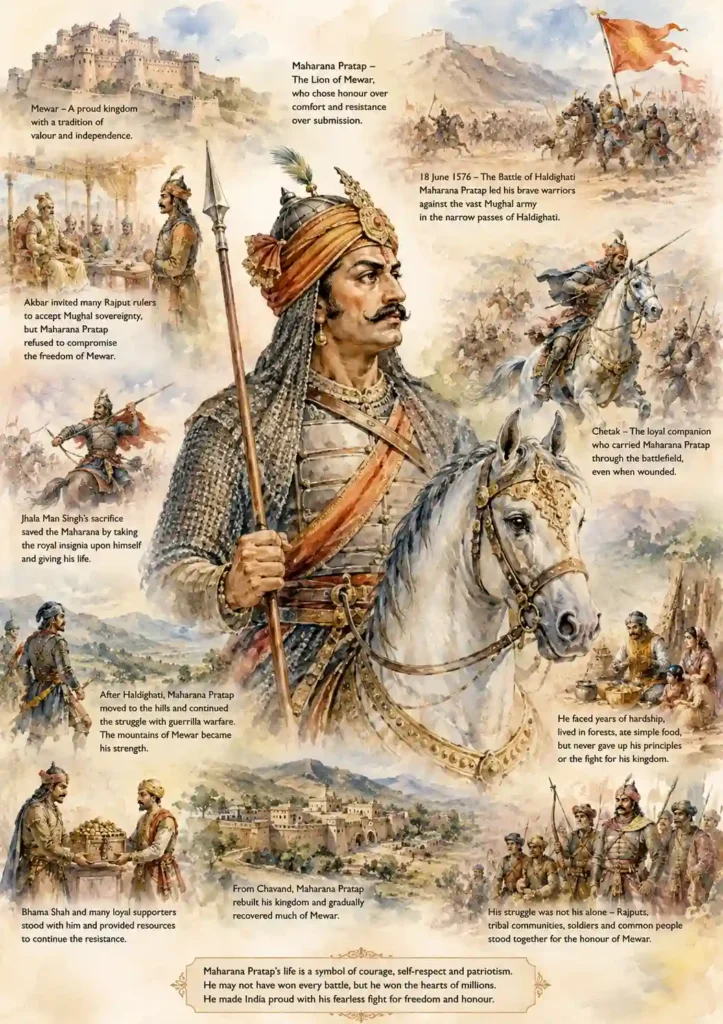
Maharana Pratap and the Kingdom of Mewar
Maharana Pratap was born in 1540 and belonged to the Sisodia Rajput dynasty of Mewar. Mewar had a proud tradition of defending its independence and political identity.
Before Pratap became ruler, Mughal forces had already captured Chittorgarh after a major siege in 1567–68. This was a serious setback for Mewar. However, the loss of Chittorgarh did not mean that the entire kingdom had been subdued.
When Pratap became Maharana in 1572, Akbar attempted to bring Mewar into the Mughal political system. Diplomatic efforts were made to persuade Pratap to accept Mughal authority. Pratap, however, refused to surrender the independence of Mewar.
For Pratap, the issue was not simply about one throne or one fort. It was about the freedom and dignity of his kingdom.
Why Did Maharana Pratap Refuse Akbar?
Akbar had successfully established political relationships with several Rajput rulers. Some Rajput states accepted Mughal authority while retaining considerable internal privileges.
Maharana Pratap chose a different path.
He believed that accepting Mughal sovereignty would compromise the independence of Mewar. His refusal eventually brought the two sides into open conflict.
This decision is one of the main reasons why Pratap occupies such a special place in Indian memory. At a time when the Mughal Empire possessed enormous military resources, he chose to continue fighting despite knowing the difficulties before him.
The Battle of Haldighati
The most famous episode in Maharana Pratap’s life is the Battle of Haldighati, fought on 18 June 1576 near the mountain pass of Haldighati in present-day Rajasthan.
The Mughal army was commanded by Raja Man Singh I of Amber, acting under Akbar. Maharana Pratap personally led the Mewar forces.
Haldighati was not a normal open battlefield. The narrow mountain terrain created serious challenges for a large army. Pratap’s forces made effective use of the difficult landscape and launched a powerful attack against the Mughal army.
Historical sources differ considerably regarding the exact size of the armies, so exaggerated numbers often repeated in popular accounts should be treated carefully. What is clear is that Pratap’s forces faced a much larger imperial military system.
The opening phase of the battle was fierce. Mewar’s warriors attacked with great determination, and Pratap himself fought on the battlefield.
The Story of Chetak
One of the most famous stories associated with Haldighati is that of Chetak, Maharana Pratap’s loyal horse.
According to the traditional account, Chetak was seriously wounded during the battle but continued carrying his master away from the battlefield. The story of the horse’s loyalty has become one of the most emotional parts of the Maharana Pratap legend.
Chetak’s sacrifice is remembered not merely as a story about a horse and a king. It represents the deep emotional connection between the warrior and the companion who stood beside him during one of the most difficult moments of his life.
The details of popular retellings should be distinguished from what can be firmly established from contemporary historical records, but Chetak remains an inseparable part of Pratap’s cultural legacy.
Jhala Man Singh’s Sacrifice
Another important incident connected with Haldighati concerns Jhala Man Singh.
During the battle, Pratap was in serious danger. Traditional accounts state that Jhala Man Singh took the royal insignia upon himself, causing enemy soldiers to mistake him for the Maharana.
This act helped Pratap escape from immediate danger.
Jhala Man Singh was killed in the fighting. His sacrifice became another powerful example of loyalty in the history of Mewar.
Such incidents explain why Haldighati continues to be remembered not simply as a military engagement but as a story of courage, loyalty and sacrifice.
Haldighati Was Not the End
One of the most important facts about Maharana Pratap is that his story did not end at Haldighati.
The battle is often simplified as a straightforward victory for one side. Historically, the situation was more complicated. Mughal forces held the battlefield, but Pratap survived and continued the struggle.
This distinction is important. A tactical setback did not destroy Mewar’s resistance.
Pratap moved into the hills and adopted methods suited to the geography of Mewar. His forces used mobility, local knowledge and surprise attacks to continue putting pressure on Mughal positions.
His resistance gradually became a long struggle rather than a single decisive battle.
Guerrilla Warfare and the Recovery of Mewar
The rugged mountains and forests of Mewar became important to Pratap’s strategy.
Instead of trying to defeat the much larger Mughal military in a conventional battle every time, Pratap relied increasingly on mobile warfare and attacks against Mughal-controlled areas.
This was a practical strategy. Mewar’s geography itself became a weapon.
Over time, Pratap succeeded in recovering substantial parts of his kingdom. Modern historical discussions also point to evidence of his later administration and territorial recovery, showing that his career cannot be understood only through the Battle of Haldighati.
Bhama Shah and the Support for Pratap
Another important figure associated with Maharana Pratap’s struggle was Bhama Shah, traditionally remembered as a loyal supporter and financial contributor to the Maharana.
The popular story says that Bhama Shah provided Pratap with wealth that helped him reorganise his forces and continue the resistance.
Whether every detail of the traditional account can be independently verified or not, Bhama Shah’s place in the story represents an important truth about Pratap’s struggle: a ruler could not continue a long war without the support of loyal commanders, administrators, soldiers and ordinary people.
Resistance was not the achievement of one man alone.
A King Who Chose Hardship
Maharana Pratap’s greatness is also remembered through stories of his personal hardships.
Popular traditions describe the Maharana and his family living in difficult conditions while he continued his struggle. Stories of eating simple food, living in forests and giving up royal comforts have become powerful symbols of his determination.
Some of these accounts belong to the later heroic tradition surrounding Pratap and should not automatically be treated as literal historical records.
Yet their popularity reveals how Indians have understood his character: a king who was prepared to sacrifice comfort for his principles.
Maharana Pratap’s Later Years
Pratap eventually established his centre at Chavand, where he spent his later years rebuilding his kingdom and administration.
He continued strengthening Mewar rather than accepting Mughal submission.
Pratap died in 1597. He did not see the complete restoration of every territory once controlled by his ancestors, but his resistance had ensured that Mewar remained a powerful symbol of independence.
Akbar’s larger objective of obtaining Pratap’s submission remained unfulfilled during Pratap’s lifetime.
Why Maharana Pratap Makes India Proud
Maharana Pratap’s importance goes beyond Rajput history.
His life represents the idea that courage does not always mean winning every battle. Sometimes courage means continuing the struggle after a setback.
Haldighati demonstrated the bravery of warriors who stood against a powerful imperial army. The years that followed demonstrated something even more important—persistence.
Pratap refused to allow defeat, hardship or loss of territory to destroy his determination.
His story also reminds us that India’s history was shaped by many different kingdoms, communities and traditions. Rajput warriors, Bhil communities, Afghan supporters and other allies participated in the wider struggle around Mewar. The resistance therefore became a broader story of people defending their homeland and political independence.
The Lasting Legacy of Maharana Pratap
Today, Maharana Pratap is remembered across India as a symbol of bravery, self-respect, sacrifice and patriotism.
The Battle of Haldighati remains one of the most famous battles in Indian history. Its 450th anniversary was observed in 2026, showing how deeply the memory of the battle continues to live in Indian public culture.
Maharana Pratap’s greatest achievement was not simply fighting a famous battle. It was his refusal to surrender his principles when doing so would have been easier.
He inherited a kingdom facing enormous challenges, lost important territories, endured years of hardship and continued fighting until he recovered much of Mewar.
For generations of Indians, this has made Maharana Pratap much more than a medieval king. He has become a symbol of India’s spirit of resistance—the belief that dignity, freedom and self-respect are worth defending even against overwhelming odds.
” a person may lose a battle, but determination can keep the spirit of freedom alive.”
Gyanavedam Categories :
Analytical Articles | Children’s Stories | Education – Building Knowledge | History and Heritage | Indian Temples and Sacred Places | Knowledge & Facts | Do You Know | Sanathana Dharma | Videos & YouTube Channel
Search all India bank IFSC codes and Pincodes Details
Maharana Pratap Kaun Hai | Maharana Parathap Kahan ke Raja the | Maharana Pratap ki Kahani