Can AI Really Replace Humans ? 8 Powerful Reasons Why Human Intelligence Still Wins
Everyone is talking about Artificial Intelligence these days. From your office to your kitchen, AI is entering every corner of life. But one big question is making rounds in every chai tapri discussion, every college seminar, every family WhatsApp group — Can AI completely replace humans?
The short answer? No. Not even close.
And in this post, we will tell you exactly why — with real, simple examples from everyday life. Because as we discovered in our deep conversations about this topic, AI has some very serious gaps that most people are not talking about.
Let’s break it down.
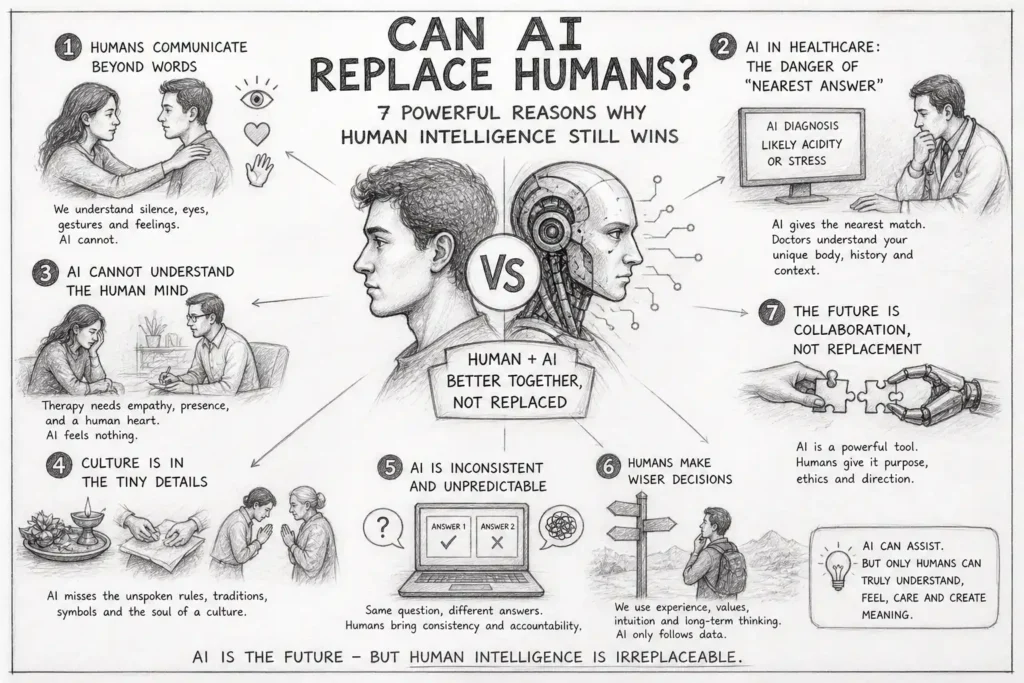
1. Humans Speak With Silence, Eyes, and Gestures — AI Simply Cannot
Think about this. When your mother looks at you across the dinner table — without saying a single word — you know she is upset. When your best friend puts a hand on your shoulder after a bad day, no words are needed. When two old friends sit quietly together and feel completely understood — that is human communication at its purest.
AI cannot do any of this.
AI works with text. It works with prompts and responses. It cannot sit in meaningful silence with you. It cannot look into your eyes. It cannot place a warm hand on your shoulder when you are breaking inside.
Human communication is embodied — it lives in the body, in physical presence, in the shared emotional space between two people. This evolved over hundreds of thousands of years. AI has existed for a few decades. The gap is enormous.
This is why terms like “human connection,” “emotional intelligence,” and “AI vs human communication” are among the most searched topics on Google today — because deep down, people sense that something critical is missing in machine-to-human interaction.
2. AI in Healthcare: The Danger of the “Nearest Answer”
Here is a very important point that not enough people discuss when they search for “AI in healthcare” or “can AI diagnose diseases.”
AI is trained on millions of medical cases. It finds patterns. It gives you the nearest matching answer based on what it has seen before. Sounds impressive, right?
But medicine does not work on “nearest answers.” Medicine works on your specific body, your specific history, your specific life context.
Imagine this situation. A 45-year-old man from Chennai goes to an AI health chatbot complaining of chest pain and fatigue. The AI looks at the pattern — most common match — and says “likely acidity or stress.” But this man has a family history of heart disease and has been under enormous work pressure for six months.
A good doctor would sense something is wrong. Would ask the right layered questions. Would notice the slight breathlessness the man did not even mention. Would order the right tests immediately.
The AI gave the nearest answer. The doctor gave the right answer.
In medicine, a wrong answer is not just incorrect — it can cost a human life. This is why “AI limitations in healthcare” and “can AI replace doctors” are among the highest searched questions in the medical and technology space right now.
3. AI Cannot Understand the Human Mind — Psychological Assessment Needs a Human Heart
When we talk about AI in mental health or AI therapy, we must be very careful.
A person sitting in a psychologist’s office is not just sharing information. They are sharing their soul. They need to feel that the person across from them genuinely cares, is genuinely moved by their story, genuinely wants them to heal.
Research consistently shows that the single biggest factor in successful therapy is not the technique — it is the quality of the human relationship between the therapist and the patient.
Now think about what a skilled psychologist actually does:
- They notice the trembling in your voice before you say something painful
- They sense the long pause before you answer a difficult question
- They read the way your body tenses when a certain topic comes up
- They sit with you in silence when words are not enough
An AI can say “I understand how painful that must be.” But it feels nothing. A sensitive patient often senses this emptiness — and it can make them feel more alone, not less.
Worse, psychological assessment deals with suicidal ideation, severe trauma, psychosis, and deep depression. Getting these wrong — giving a generalised nearest answer — could push someone deeper into crisis rather than toward healing.
This is not a small risk. This is a matter of life and death.
4. Culture Is in the Tiny Details — And AI Will Always Miss Them
This point is perhaps the most overlooked and the most important when we discuss “AI limitations” in real life.
Culture does not live in textbooks. Culture lives in the tiny, unspoken, unwritten things that are passed from one generation to the next through family, food, festivals, and feeling.
Consider these examples:
- In many Indian homes, you never hand money directly into another person’s palm during auspicious occasions — you place it on a surface or in a cloth. AI does not know this.
- In certain South Indian communities, addressing an elder by their first name — even casually — is considered deeply disrespectful. AI will not sense this.
- The way a Punjabi family celebrates is completely different from the way a Tamil Brahmin family celebrates — even if both are celebrating the same festival. AI flattens all of this into one generic description.
- In many tribal communities across India, silence during a community gathering is not awkward — it is respectful and participatory. AI would completely misread this.
These are not minor details. These are identity, respect, belonging, and dignity.
When AI gets culture wrong, it does not just make an error — it can reinforce harmful stereotypes, deeply offend communities, and misrepresent groups that are already misunderstood.
A person raised within a culture carries knowledge that is felt, embodied, emotional, and generational. This knowledge does not live in data. It lives in people.
AI can study culture from the outside. But it will always be a stranger looking through a window — never truly inside the room.
5. The Consistency Problem: AI Gives Different Answers Each Time
Here is a technical reality that has very serious real-world consequences — and one of the top concerns when people search for “AI reliability” or “problems with AI chatbots.”
Ask an AI the same question today and again tomorrow. You may get two completely different answers — delivered with the same calm, confident tone both times.
This happens because AI does not retrieve a fixed truth. It constructs an answer fresh every time, using probability and randomness built into its system. Its training data also contains contradictions — because the internet itself is full of conflicting information.
Now think about what this means in real situations:
In medicine — Session one says your symptom is minor. Session two flags it as serious. Which do you follow? A wrong choice could cost your life.
In psychology — A person in emotional crisis gets one coping strategy today and a contradictory approach tomorrow. A fragile mind does not need more confusion.
In law and finance — Session one says an action is legally safe. Session two suggests it carries risk. A person makes a major life decision — and the consequences could be devastating.
In education — A student builds their understanding on shifting, inconsistent ground. Their learning becomes unstable and unreliable.
The most dangerous part? AI always sounds confident. Whether it is right or wrong. Whether it is consistent or contradicting yesterday’s answer entirely. It gives no signal that this answer may be completely different from last time.
A human expert who is uncertain sounds uncertain. That hesitation is itself valuable information. It tells you to verify, to dig deeper, to seek a second opinion.
AI’s false confidence, combined with its inconsistency, is one of the most quietly dangerous things about over-relying on it.
6. Humans Have Accountability — AI Does Not
This is a simple but profound point.
When a doctor makes a wrong diagnosis, they are accountable — professionally, legally, morally. When a lawyer gives bad advice, they answer for it. When a teacher misleads a student, there are consequences.
When AI gives wrong information — who do you hold responsible?
No one.
There is no entity that truly “owns” an AI’s mistake the way a human professional does. There is no one you can look in the eye and say, “You got this wrong. People suffered because of your error.”
This absence of accountability is not just a legal or technical problem. It is a moral problem. And it becomes critically important when AI is being used in high-stakes areas like healthcare, mental health, legal advice, and financial planning.
Humans are not just more capable in many areas — they are answerable in a way that AI simply is not.
7. The Right Relationship Between AI and Humans: Collaboration, Not Dependence
So where does all this leave us?
AI is a remarkable tool. It can process enormous amounts of data in seconds. It can assist doctors in reviewing scans. It can help teachers find new ways to explain difficult concepts. It can help businesses understand patterns. It can help all of us save time on repetitive tasks.
But a tool that gives different answers each time is not fully reliable. A tool that cannot feel, cannot sense culture, cannot sit in silence with you, cannot truly understand your specific medical or psychological situation — that tool cannot replace the human beings who can do all of these things.
The healthiest approach — and the one most supported by research and common sense — is AI as an assistant to human capability, not a replacement for human judgment.
Use AI to move faster. Use AI to handle the repetitive. Use AI to explore possibilities. But always keep a human being in the loop for decisions that matter — in medicine, in mental health, in cultural contexts, in law, in education, in anything that touches real human lives.
8. Your Secrets Are Not Safe — AI Stores Everything You Share
When a person pours their heart out to an AI — sharing personal problems, health struggles, family conflicts, mental pain — they feel they are speaking to something safe and private. But here is the hard truth nobody tells you upfront.
Everything you share with AI is potentially stored in a database.
You trust it like a diary. But it behaves more like a public notice board with a lock that others may have a key to. Your sensitive confessions — your medical history, your relationship problems, your financial stress, your deepest fears — can be accessed, analysed, or exposed in ways you never agreed to or imagined.
A human confidant — a doctor, a therapist, a trusted friend — is bound by professional ethics, personal loyalty, and the law of confidentiality. They carry your secrets in their heart, not in a server.
AI carries your secrets in a database. And databases get breached, shared, sold, and studied. That trust you placed in the machine? It cannot always be guaranteed.
This is why “AI data privacy” and “is AI conversation safe” are among the fastest growing search concerns globally today. People are beginning to realise — sharing your soul with a machine may cost you more than you bargained for.
Did this article make you think differently about AI? Share it with someone who needs to read this. And tell us in the comments — where do you think AI should never replace humans?
can AI replace humans | AI limitations 2025 | artificial intelligence vs human intelligence | AI in healthcare risks | AI mental health limitations | AI and Indian culture | AI inconsistency | human connection AI cannot replace | future of AI | AI vs humans India | AI Stores Everything You Share | Can AI Really Replace Humans ?
Gyanavedam Categories :
Analytical Articles | Children’s Stories | Education – Building Knowledge | History and Heritage | Indian Temples and Sacred Places | Knowledge & Facts | Do You Know | Sanathana Dharma | Videos & YouTube Channel | Hindu Festival Calender 2026