
10 Ancient Indian Inventions That the World Uses Today (But Few People Know Came from India)
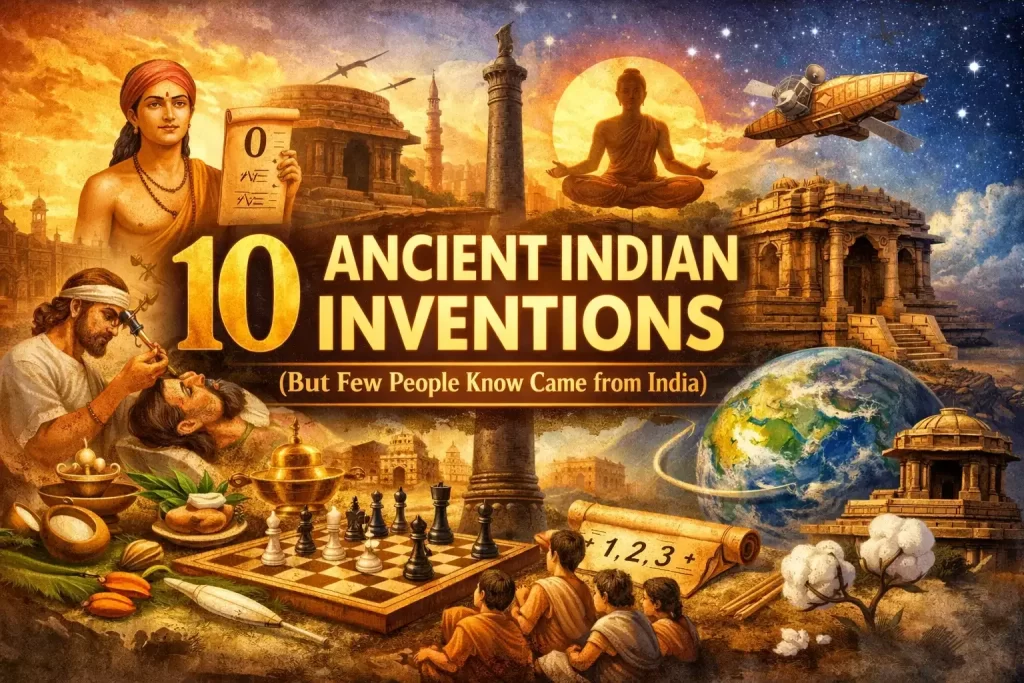
10 Ancient Indian Inventions That the World Uses Today : Throughout history, civilizations across the world have contributed to human progress, but ancient India holds a uniquely rich and often under-recognized place in the development of science, mathematics, medicine, philosophy, and daily life practices.
Many concepts that shape modern society—whether in education, health, engineering, or technology—have roots that trace back thousands of years to the Indian subcontinent.
Today, when we use numbers, play games, practice meditation, or even study urban planning, we rarely realize how deeply these ideas are connected to ancient Indian knowledge systems. Understanding these contributions not only builds awareness but also helps us appreciate how knowledge travels across time and cultures.
Here are ten remarkable inventions and discoveries from ancient India that continue to influence the modern world.
1. The Number Zero and the Decimal System
One of the most significant contributions of ancient India to global civilization is the concept of zero and the decimal system. Without zero, modern mathematics, engineering, and computing would not exist in their current form.
Indian mathematicians such as Aryabhata and later Brahmagupta developed the place-value system and formal rules for using zero in calculations. This system made arithmetic simpler and more efficient, enabling complex mathematical operations that were difficult in earlier numeral systems.
Today, computers, digital technology, and scientific calculations all depend on numerical systems derived from these early Indian concepts.
Did you know? Every time a computer processes data in binary form, it relies on mathematical principles that evolved from the decimal system first developed in India.
2. Ayurveda and Ancient Medical Science
Ayurveda, one of the world’s oldest systems of medicine, originated in India more than 3,000 years ago. It focuses on balancing the body, mind, and environment to maintain health and prevent disease.
Ancient texts such as the Charaka Samhita and Sushruta Samhita describe detailed methods of diagnosis, herbal medicine, diet, and surgical techniques. Sushruta, often called the “Father of Surgery,” documented procedures including cataract surgery and early forms of plastic surgery.
Modern wellness practices such as herbal remedies, preventive health care, and holistic healing draw inspiration from Ayurvedic principles.
Did you know? Many herbal treatments used in modern alternative medicine have origins in Ayurvedic knowledge.
3. Chess – The Game of Strategy
The modern game of chess evolved from an ancient Indian game called Chaturanga, which was played as early as the 6th century. The game represented four divisions of the army: infantry, cavalry, elephants, and chariots.
From India, the game spread to Persia, then to the Arab world, and eventually to Europe, where it developed into modern chess.
Today, chess is played worldwide and is recognized as one of the most intellectually stimulating games, used even in education to improve concentration and strategic thinking.
Did you know? The word “checkmate” comes from the Persian phrase “Shah Mat,” meaning “the king is helpless.”
4. Cotton Cultivation and Textile Techniques
India was one of the earliest regions in the world to cultivate cotton and produce cotton textiles. Archaeological evidence from the Indus Valley Civilization shows that cotton was spun and woven more than 4,000 years ago.
Indian textiles became highly valued in ancient trade, and techniques developed by Indian weavers influenced textile production in many parts of the world.
Even today, cotton remains one of the most widely used natural fibers globally, and India continues to be one of the largest producers of cotton.
Did you know? The word “calico,” referring to cotton cloth, originates from Calicut (Kozhikode), a historic Indian trading port.
5. Yoga and Meditation
Yoga and meditation originated in ancient India as practices for physical, mental, and spiritual well-being. Ancient texts such as the Yoga Sutras of Patanjali describe systematic methods to control the mind, improve health, and achieve inner balance.
In modern times, yoga has become a global movement practiced by millions of people for fitness, stress relief, and mindfulness.
Scientific research today confirms many benefits of yoga and meditation, including improved concentration, reduced stress, and better physical health.
Did you know? The United Nations recognizes June 21 as the International Day of Yoga, reflecting the global impact of this ancient Indian practice.
6. Urban Planning in the Indus Valley Civilization
The cities of the Indus Valley Civilization, such as Mohenjo-daro and Harappa, demonstrate advanced urban planning more than 4,000 years ago.
These cities had:
- Well-planned streets arranged in grids
- Sophisticated drainage systems
- Standardized bricks and construction methods
- Public baths and water management systems
Many principles used in modern city planning—such as drainage design and organized street layouts—reflect concepts that existed in these ancient cities.
Did you know? The drainage systems of the Indus Valley were so advanced that some modern engineers still study them for insights.
7. Discoveries in Astronomy
Ancient Indian astronomers made remarkable observations about the movement of planets, eclipses, and the rotation of the Earth.
Aryabhata proposed that the Earth rotates on its axis, explaining the cycle of day and night centuries before similar ideas gained acceptance elsewhere. Indian astronomers also calculated planetary positions with impressive accuracy using mathematical models.
Astronomy in ancient India combined observation, mathematics, and philosophy, laying the groundwork for later developments in space science.
Did you know? Ancient Indian astronomers calculated the length of a year with surprising precision, close to modern measurements.
8. Metallurgy and the Iron Pillar of Delhi
The Iron Pillar in Delhi, built more than 1,600 years ago, is famous for its resistance to rust. Despite centuries of exposure to weather, the pillar has not corroded significantly.
This demonstrates the advanced metallurgical skills of ancient Indian craftsmen, who developed techniques for producing high-quality iron and steel.
Indian metallurgy also influenced the production of Damascus steel, which became famous for its strength and sharpness.
Did you know? Scientists continue to study the Iron Pillar to understand the corrosion-resistant technology used in its creation.
9. The Gurukula System of Education
Ancient India developed one of the earliest organized systems of education known as the Gurukula system. In this system, students lived with their teacher and learned not only academic subjects but also discipline, ethics, and practical skills.
Education in ancient India emphasized holistic development—intellectual, physical, and moral.
Modern educational ideas such as experiential learning, mentorship, and value-based education share similarities with the Gurukula tradition.
Did you know? Universities like Takshashila and Nalanda attracted students from many parts of the world thousands of years ago.
10. The Concept of the Decimal Place Value System
In addition to zero, ancient Indian mathematicians developed the decimal place value system, which allows numbers to be written efficiently using ten digits.
This system made arithmetic operations easier and more practical, enabling progress in trade, astronomy, engineering, and science.
The decimal system eventually spread to the Middle East and Europe, becoming the standard numerical system used worldwide today.
Did you know? Without the decimal place value system, modern accounting, banking, and scientific measurement would be extremely difficult.
Why These Discoveries Matter Today
The contributions of ancient India were not isolated achievements. They formed part of a broader tradition that valued observation, logic, experimentation, and knowledge sharing.
These inventions demonstrate that scientific thinking and innovation have deep roots in human history, and many modern advancements are built upon foundations laid centuries ago.
Understanding this history helps us appreciate the continuity of knowledge and the importance of preserving and sharing cultural and scientific heritage.
Conclusion
Ancient India was not only a land of traditions and philosophy but also a center of remarkable scientific and intellectual achievements. From mathematics and medicine to urban planning and education, Indian scholars and thinkers contributed ideas that continue to shape modern civilization.
When we study these contributions, we realize that knowledge is timeless. Innovations from the past continue to influence the present and inspire the future.
The story of human progress is a shared story, and ancient India holds an important chapter in that journey—a chapter filled with discovery, curiosity, and wisdom that still resonates today.
Subscribe Gyanavedam Youtube Channel (Click Here to Subscribe)