
Winter Olympics 2026: The Ultimate Guide to Milano Cortina — History, Heroes, Records & Everything You Need to Know
The 25th Winter Olympic Games are unfolding right now across the breathtaking landscapes of Northern Italy — and the world simply cannot look away. From record-shattering athletes to brand-new sports, historic firsts, and a sustainability revolution, Milano Cortina 2026 is rewriting what a Winter Olympics can be. This is your definitive, deep-dive guide to everything happening at the XXV Olympic Winter Games.
What Are the Winter Olympics 2026? The Big Picture
The 2026 Winter Olympics, officially known as the XXV Olympic Winter Games, are being held from February 6 to February 22, 2026, across the stunning alpine terrain and vibrant cities of Northern Italy. Following the Games, the Paralympic Winter Games will take place from March 6 to 15, 2026.
The scale is extraordinary: 2,900 athletes from 92 National Olympic Committees (NOCs) are competing across 116 medal events, 16 disciplines, and 8 sports. Three nations — Benin, Guinea-Bissau, and the United Arab Emirates — are making their Winter Olympic debut, a powerful reminder that winter sport’s global footprint continues to grow.
When, Where & How: Dates, Cities, and Venues
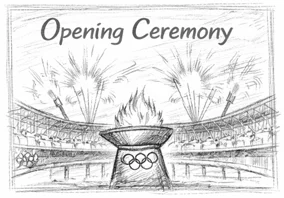
Opening Ceremony: February 6, 2026 — San Siro Stadium, Milan Closing Ceremony: February 22, 2026 — Verona Arena (a 2,000-year-old Roman amphitheatre) Primary Host Cities: Milan (Milano) and Cortina d’Ampezzo
Competition Sites Across Northern Italy
The Games span 15 venues across 8 locations — making this the most geographically spread Winter Olympics in history, covering over 22,000 square kilometers of Northern Italy:
- Milan (Milano): Figure skating, short track speed skating, ice hockey, and speed skating at world-class indoor arenas including the Milano Santagiulia Ice Hockey Arena.
- Cortina d’Ampezzo: Women’s alpine skiing, curling, bobsleigh, luge, and skeleton — set against the iconic Dolomite peaks.
- Bormio: Men’s alpine skiing and ski mountaineering.
- Livigno: Snowboarding and freestyle skiing — a paradise for younger, action-sport fans.
- Predazzo & Val di Fiemme: Nordic combined, ski jumping, and cross-country skiing.
- Rasen-Antholz: Biathlon amid the dramatic South Tyrolean mountains.
- Tesero: Cross-country skiing trails through pine-studded valleys.
- Verona: Host of the closing ceremony at the ancient Verona Arena.
Why This Matters: For the first time in Olympic history, the Games are officially co-hosted by two major cities. This “dual-city, territorial” model is the IOC’s answer to a more sustainable, decentralized Olympic future — using existing world-class venues instead of building costly new infrastructure.
A Historic Opening: Two Cauldrons, One Ceremony

The Opening Ceremony was a breathtaking spectacle of art, culture, and Italian flair. Hosted at San Siro Stadium — one of the most iconic football venues on earth — the ceremony was themed “Armonia” (Harmony), a celebration of unity across a divided world.
In a moment that made Olympic history, two Olympic cauldrons were simultaneously lit — one in Milan, one in Cortina d’Ampezzo — symbolising the dual-city spirit of the Games. This is the first time in Olympic history that two cauldrons have burned at the same time.
The Olympic Torch itself deserves a mention: fuelled by Bio-LPG and crafted from recycled materials, it is the first Olympic torch ever to receive “ReMade Class A” certification — a fitting symbol for the greenest Winter Games ever staged. Before reaching Milan, the flame travelled over 12,000 km across Italy in one of the most extensive torch relay routes in Olympic history.
New Sports, New Events: The 2026 Program Is Unlike Any Before It

The 2026 program pushes the boundaries of what Winter Olympics looks like, with several brand-new events generating massive global buzz.
Ski Mountaineering (SkiMo): The Sport That Stole the Show
The single most talked-about development of these Games is the Olympic debut of ski mountaineering (SkiMo) — a grueling, visually spectacular sport in which athletes race uphill using grip “skins” attached to their skis, then switch to rapid downhill skiing across rugged mountain terrain. It demands elite endurance, technical skill, and lightning-quick transitions.
Sprint races — compact, explosive, and thrilling — have captivated first-time viewers, while the mixed-team relay has added an extra layer of national pride. Medals are contested in men’s and women’s sprints and the mixed relay.
Historic Gold: Spain’s Oriol Cardona Coll won the very first Olympic gold medal in ski mountaineering men’s sprint, etching his name into history on the opening days of the Games. Switzerland’s world champion won the women’s event in a stunning final.
Other Brand-New Events in 2026
- Women’s Large Hill Ski Jumping — a long-overdue addition bringing gender parity to one of winter sport’s most dramatic disciplines
- Women’s Doubles Luge — adding female competitors to the fastest discipline on ice
- Mixed Team Skeleton — nations’ top male and female sliders combining for a relay format
- Men’s and Women’s Dual Moguls — a head-to-head freestyle skiing showdown that’s been an instant fan favourite
- Team Combined in Alpine Skiing — already producing razor-thin drama and a rare shared silver medal outcome
- NHL Stars Return to Ice Hockey — after a 12-year absence, NHL players are back in the Olympic men’s hockey tournament, guaranteeing the highest level of competition since Turin 2006
The Stars of Milano Cortina 2026

Mikaela Shiffrin — The Alpine GOAT Reclaims Her Crown
No story at these Games has captivated the world more than the triumph of Mikaela Shiffrin. The American skiing legend entered 2026 with a staggering 108 World Cup victories — including 71 in slalom alone — and seven World Championship titles. On Day 12, she delivered one of the most memorable performances in alpine skiing history.
Shiffrin won her second Olympic slalom gold medal, 12 years apart from her first — completing a dominant two-run performance with a combined time of 1:39.10 and a margin of victory of 1.50 seconds. It is the defining moment of her career — and possibly the defining image of these Games. The skiing world erupted.
Johannes Høsflot Klæbo — Chasing Olympic Immortality
Norway’s cross-country powerhouse Johannes Høsflot Klæbo is on the cusp of becoming the greatest Winter Olympian in history. The 29-year-old won his 10th Olympic gold medal at these Games, joining a tiny elite of athletes to reach that milestone and cementing his position among the all-time legends of sport. Every race he enters is now a historic event in itself.
Francesca Lollobrigida — Italy’s Speed Skating Queen
In front of her home fans, Italy’s Francesca Lollobrigida produced a golden double in speed skating — winning gold in both the women’s 3,000m and 5,000m. Her 5,000m gold was Italy’s first-ever Olympic gold medal in that event. Cue pandemonium in the stands.
Jordan Stolz — America’s Breakout Star
American speed skater Jordan Stolz has become an overnight household name, winning gold in both the men’s 500m and 1,000m. In a sport that rarely dominates U.S. headlines, Stolz’s double-gold performance has introduced speed skating to an entirely new generation of American fans.
Xu Mengtao — Two-Time Aerial Champion
China’s Xu Mengtao achieved what no athlete had ever accomplished before: winning two Olympic gold medals in aerials. She successfully defended her title with a winning score of 112.90, cementing herself as the greatest aerial freestyle skier in Olympic history.
Franjo von Allmen & Switzerland — Alpine Dominance
Switzerland’s Franjo von Allmen has been the breakout star of alpine skiing, capturing gold in the Downhill, Super-G, and Team Combined. Loïc Meillard added gold in slalom, and Marco Odermatt contributed three more medals. The Swiss have been simply dominant on the slopes — and are making an extraordinary run at the alpine skiing medal count.
Jakara Anthony — Australia’s Moguls Queen
Australia’s Jakara Anthony won gold in the debut dual moguls event, delivering a shining moment for winter sports nations beyond the traditional European and North American strongholds.
Fukada Mari — Japan’s Teenage Sensation
Nineteen-year-old Japanese snowboarder Fukada Mari won women’s slopestyle gold on her Olympic debut, becoming an instant icon and proving that youthful brilliance can conquer the biggest stage in sport.
Medal Table: Who Is Leading at Milano Cortina 2026?
As of Day 12 (February 18, 2026), the medal standings are fierce and close:
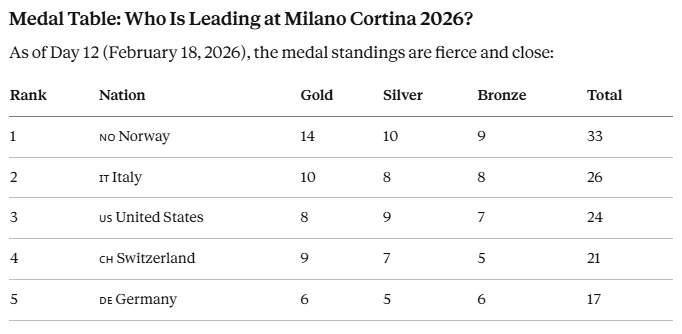
Norway leads convincingly and is on track to become the first nation in 20 years to top the medal count at three consecutive Winter Olympic Games. Italy’s 26-medal haul is already the best in the country’s Winter Olympic history — and the Games aren’t over yet. For Team USA, freestyle skiing has driven six podium finishes, with six American athletes winning multiple medals.
Historic Moments You Simply Cannot Miss
🇧🇷 Brazil Wins Its First-Ever Winter Olympic Medal — and It’s Gold In one of the most emotionally charged moments of any Olympic Games in recent memory, Brazil won its first-ever Winter Olympic medal — and made it a gold. Brazil became the first tropical nation, the first Latin American, and the first South American NOC to win a Winter Olympics gold medal. This goes far beyond sport — it is a cultural watershed moment.
🇬🇪 Georgia Makes Winter Olympic History Georgia won its first-ever Winter Olympic medal at these Games, adding another nation to the map of winter sport and underscoring how the Olympics continue to broaden their global reach.
🇮🇹 Italy’s Greatest Winter Games — On Home Snow With 26 medals and counting, Italy is having its greatest Winter Olympics ever. Athletes like alpine star Sofia Goggia are delivering podium finishes to thunderous home crowds in Cortina d’Ampezzo — the emotional intensity of which is simply unmatchable.
A Shared Silver Medal in Alpine Skiing In the Men’s Alpine Team Combined, Austria and Switzerland tied for silver — with no bronze awarded. One of the most unusual outcomes in recent Olympic memory, and a reminder that the margins at this level are razor-thin.
Fun Facts & Things You Didn’t Know About the 2026 Winter Olympics
- This is the 25th edition of the Winter Olympics — a silver jubilee for the Winter Games.
- Cortina d’Ampezzo last hosted the Winter Olympics in 1956 — making 2026 a 70-year homecoming for the legendary resort.
- The Olympic medals were unveiled in Venice — the Floating City — and were crafted from recycled industrial metals, shaped as two interlocking halves representing an athlete’s journey and their support network.
- Snoop Dogg is back as an NBC correspondent, bringing his inimitable energy from LA to the Italian Alps.
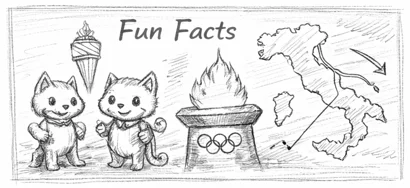
- The mascots — Tina and Milo — are two stoat siblings designed by Italian schoolchildren. Tina represents the Olympics and Milo the Paralympics.
- The Closing Ceremony will be held at the Verona Arena — a Roman amphitheatre built in 30 AD that has hosted gladiators, operas, and now Olympic history.
- These are the most gender-balanced Winter Games in history, with 47% female athlete participation.
- The distance between Milan and Cortina is over 400 km, requiring six separate Olympic Villages for athletes.
- Temperatures in Cortina d’Ampezzo have warmed by over 3.6°C since the 1950s, making these Games a vivid, real-world symbol of climate change’s threat to winter sports.
- The Olympic Village in Milan’s Porta Romana district will be converted after the Games into the city’s largest student housing complex — a legacy that will benefit thousands for decades.
Sustainability: The Greenest Winter Olympics Ever?
Milano Cortina 2026 is setting a new global benchmark for environmental responsibility, and the numbers back it up:
92% of all venues are either existing structures or temporary installations — no white elephants, no wasted billion-dollar facilities collecting dust after the flame goes out.
Olympic medals are crafted from recycled metals sourced from industrial waste, designed with Italian craftsmanship and circular economy principles. Renewable energy powers the majority of venues. A low-carbon transport plan — including HVO biofuel-powered shuttle buses — dramatically reduces the Games’ carbon footprint. And the IOC’s “New Norm” framework has ensured spending is controlled, with the economic model focused on long-term community benefit rather than short-term spectacle.
The $6 billion economic impact projected for Italy goes beyond the Games themselves: railway upgrades, healthcare improvements in mountain regions, and digital infrastructure rollouts across Lombardy and Veneto are all part of the legacy plan.
Why These Games Matter Beyond the Medals
The Milano Cortina 2026 Winter Olympics arrive at a pivotal moment. Climate change is shrinking natural snow seasons. Questions about Olympic sustainability and cost have never been louder. And the global geopolitical landscape has made large-scale international unity rarer and more precious.
Yet here, on the slopes of the Dolomites and the ice of Milan’s arenas, athletes from 92 nations are competing in the spirit of friendship, excellence, and respect. When Brazil wins a Winter Olympic gold — a country built on beaches and carnivals — it tells us something profound: sport transcends geography, history, and expectation.
When a teenager from Japan wins Olympic slopestyle gold on her debut, when a 29-year-old Norwegian collects his 10th Olympic medal, when an American speed skater becomes famous overnight — these are the stories that remind us why the Olympics still matter.
The inclusion of ski mountaineering, the expansion of women’s events, the debut of three new nations, and the sustainability revolution underway all signal that the Winter Olympics are not standing still. They are evolving — faster, bolder, and with greater purpose than ever before.
How to Watch the 2026 Winter OlympicsThe Games continue until February 22, 2026. Here’s where to watch:
- USA: NBC, Peacock, and NBCOlympics.com (live streams around the clock)
- Europe: Eurosport and its national broadcast partners
- India: JioHotstar
- Global: Check your local broadcaster for region-specific live rights
If you’re in Italy, Milan’s Live Sites are broadcasting every event on giant outdoor screens, surrounded by incredible Italian food, music, and atmosphere — the next best thing to being in the mountains.
Final Word: A Winter Olympics for the Ages
From Mikaela Shiffrin’s triumphant return to Klæbo’s historic 10th gold, from Brazil’s emotional first-ever Winter Olympic victory to the birth of ski mountaineering as an Olympic sport — Milano Cortina 2026 is one of the most extraordinary Winter Games ever staged.
Italy has given the world a Winter Olympics that is sustainable, spectacular, and deeply human. With Cortina’s 70-year return to Olympic glory, Milan’s cosmopolitan glamour, and the timeless beauty of the Dolomites as a backdrop — this is more than a sporting event. It is a love letter to winter, to sport, and to the enduring belief that the world, brought together, is capable of something magical.
The flame burns in Milan. The snow gleams in Cortina. And the world is watching.
Analytical Articles | Children’s Stories | Education – Building Knowledge | History and Heritage | Indian Temples and Sacred Places
Knowledge & Facts | Do You Know | Sanathana Dharma | Videos & YouTube Channel